History of Jubilee Year: The Holy Year in Rome

Jubilee Year 2025. Image: Archdiocese of Cincinnati
History of Jubilee Year: The Holy Year in Rome

This year, 2025, is a Jubilee Year for the Roman Catholic Church, also known as a Holy Year. In my last article, I discussed how many would make the pilgrimage to Rome from Canterbury along the Via Francigena.
What is the origin of a Jubilee Year, how has it been observed in the past, and what does it mean for this year?
Jubilee in the Bible
In the Old Testament book of Leviticus, a Jubilee Year is ordered to occur every 50 (or after 49) years; during which slaves and prisoners would be freed, debts would be forgiven, and the mercies of God would be particularly manifest.
Leviticus 25:8–12 states:
You shall count off seven Sabbaths of years, seven times seven years; and there shall be to you the days of seven Sabbaths of years, even forty-nine years. Then you shall sound the loud trumpet on the tenth day of the seventh month.
On the Day of Atonement, you shall sound the trumpet throughout all your land… proclaim liberty throughout the land to all its inhabitants… return to his property… and clan… you shall neither sow nor reap… you may eat the produce of the field.

Shofar: Ram’s Horn. Image: Wikipedia

The word “Jubilee” is derived from the Hebrew word meaning “ram’s horn trumpet,” signifying the blast on a shofar (made of a ram’s horn) announcing the Jubilee Year during that year’s Yom Kippur high holy day.
Jubilee in Roman Catholic History
In the Roman Catholic Church since the Middle Ages, Jubilee Year begins with the opening of the Holy Door, with the first pilgrim to cross the threshold being the Bishop of Rome, the Pope himself.
However, the “seat” of the Bishop of Rome – cathedral means “chair of the bishop” – up until the 16th century was not St. Peter’s Basilica at the Vatican, but instead the Archbasilica of St. John Lateran in Rome.

St. John’s Lateran, Rome. Author’s photo
- In 1300, Pope Boniface VIII declared a Holy Year, intending that it should be celebrated once every 100 years.
- In 1343, Pope Clement VI, who was residing in Avignon, changed it to every 50 years.
- In 1470, Pope Paul II decreed that the Jubilee should be celebrated every 25 years, and this has been the standard rule ever since, though extraordinary Jubilees may be declared as needed. A Jubilee Year usually involves a pilgrimage to a sacred site, normally the city of Rome.
In 1423, Pope Martin V first opened the Holy Door of St. John’s Lateran during a Jubilee year. It was not until 1499 that Pope Alexander VI opened the Holy Door not only there, but also at the other Roman basilicas.

Holy Doors, St. John’s Lateran. Author’s photo
Historical Trivia:
The bronze doors of St. John’s Lateran, standing about 50 feet high, are reputed to be the largest in the world. They were from the Curia Julia (Senate House), initially in the Forum. They were commissioned by the Roman General Sulla in 80 B.C. and were rebuilt by Julius Caesar in 44 B.C. Emperor Augustus finished them. They were moved to St. John’s Lateran at the request of Pope Alexander VII in the mid-1600s.
Today, Jubilee Years attract millions of pilgrims to Rome. However, in the mid-1400s, the city had a population of only 30,000. Rome was primarily rural, unlike the economic metropolises of Milan, Florence, and Venice. Nevertheless, the 1450 Jubilee attracted 40,000 pilgrims to Rome every day. With them came the plague, and some members of the Catholic governing body died of the infection.
By the time of the 1550 Jubilee, the Protestant Reformation was in full swing in Europe. Even then, between 200,000 and 300,000 pilgrims visited Rome.
Today, pilgrims who take the Via Francigena to Rome and have their pilgrim’s passport stamped at any of the 80 stops along the way can have their testimonium authorized.

Certification of “testimonium” in Rome, issued to those who walked the final 100 km.

Testimonium, “certificate of pilgrimage completed to the thresholds of Peter”
Here are pilgrim friends who have arrived in St. Peter’s in Rome.

Pilgrims at St. Peter’s
Roman Catholic Dogma on Jubilee Indulgence
According to the dogma of the Roman Catholic Church:
“A plenary indulgence is a grace granted by the Catholic Church through the merits of Jesus Christ to remove the temporal punishment due to sin.”
A plenary indulgence cleanses the living soul such that they need not go to Purgatory, where they would otherwise need to be “purged” of their sins before entering Heaven. Plenary indulgences obtained during the Jubilee Year can also be applied to deceased souls in Purgatory, with the possibility of obtaining two plenary indulgences for the deceased in one day, according to the Apostolic Penitentiary.
Catholics who make the pilgrimage to Rome during the 2025 Jubilee Year may obtain a plenary indulgence by visiting at least one of the four major papal basilicas in Rome:
- St. Peter’s Basilica
- Archbasilica of St. John Lateran
- Basilica of St. Mary Major
- Basilica of St. Paul Outside the Walls
Additionally, the Catholic pilgrim is required to meet the conditions of: detachment from all sin, sacramental confession, holy Communion, and prayer for the intentions of the Pope.
Other kinds of indulgences are granted through pilgrimages to churches in Rome, Italy, and the Holy Land.
Jubilee Today

Pope Francis on December 8, 2015, opening the Holy Door in St. Peter’s Basilica. Image: Vatican News
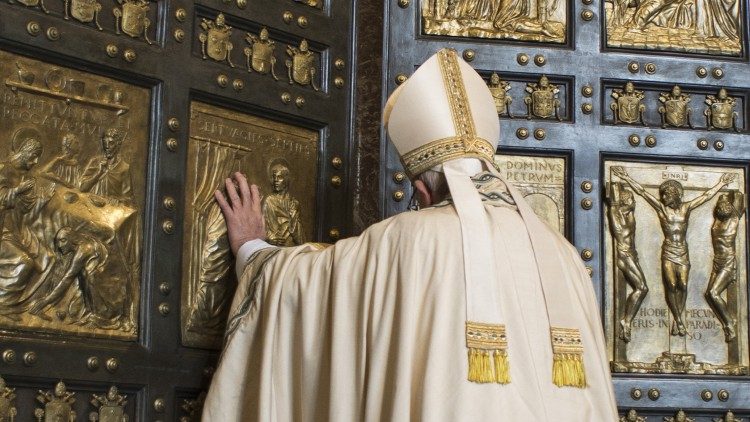
The 88-year-old Pope Francis initiated the 2025 Holy Year last December 24, by knocking a few times on the great Holy Door of St. Peter’s Basilica, whereupon it opened amid bells tolling across Rome. He designated the 2025 Jubilee as a time of renewal, calling it “Pilgrims of Hope.”
Pope Leo XIV, elected on May 8, 2025, through the process of Conclave, is expected to welcome millions of pilgrims to Rome this year.
Follow-up: On January 6, 2026, Leo XIV formally closed the 2025 Holy Year, sealing the Holy Door of St. Peter’s Basilica during the Epiphany service, bringing to a close a Jubilee that had attracted 33 million pilgrims from 185 countries, led by Italy, the US, Spain, Brazil, and Poland. He announced a special Jubilee for 2033 to mark 2,000 years since the death and resurrection of Jesus.
Bill Petro, your friendly neighborhood historian
billpetro.com
