Northern Lights and Coronal Mass Ejection: Existential Threat from Methanogenic Cattle

Coronal Mass Ejection from our Sun, with Earth to scale. (Not actual size)
NORTHERN LIGHTS AND CORONAL MASS EJECTION: METHANOGENIC CATTLE
NOAA (National Oceanic and Atmospheric Administration) has announced a G2 geomagnetic storm watch for tomorrow, August 28, which could potentially boost aurora activity.

Northern Lights, Crystal Pape, Hastings, Nebraska. Image: Fox Now
Coronal Mass Ejections (CMEs) are plasma and magnetic field explosions from the Sun’s corona. When aimed at Earth, they trigger geomagnetic storms that affect infrastructure in near-Earth orbit and on the surface. These storms can disrupt various systems, such as electric power grids, GPS navigation, and Netflix.
Climate scientists have finally recognized an unprecedented existential threat to the Earth, as evidenced by the recent ejection of a coronal mass from the Sun earlier today, with another predicted for Saturday, August 29. Arrival times vary based on speed; some can arrive in as little as 15–18 hours, while slower CMEs may take several days to reach Earth.
What’s causing this?
The Science of Solar Climate Change
It’s all due to the insidious increase in bovine flatulence, as I’ll explain below.
For too long, our climate scientists focused only on climate change on Earth; thankfully, they have lifted their gaze from the ground and finally turned their eyes to the skies. Our Sun is in trouble. And that means all of us are in trouble.
All too often, the uninformed citizen has been concerned only with carbon dioxide emissions from the tailpipes of their automobiles. But now, the whiff of danger from methane has warned us, almost too late.
In 2019, 590 million tons of methane were released globally. According to the 2021 Global Methane Assessment, methane emissions from livestock (including cattle) are the largest source of agricultural emissions worldwide. Enteric fermentation by ruminant livestock produces 100kg of methane per cow per year! In layman’s terms, it’s a cacophony of cattle crepitation. Where does it go? It goes up – up to the Sun.
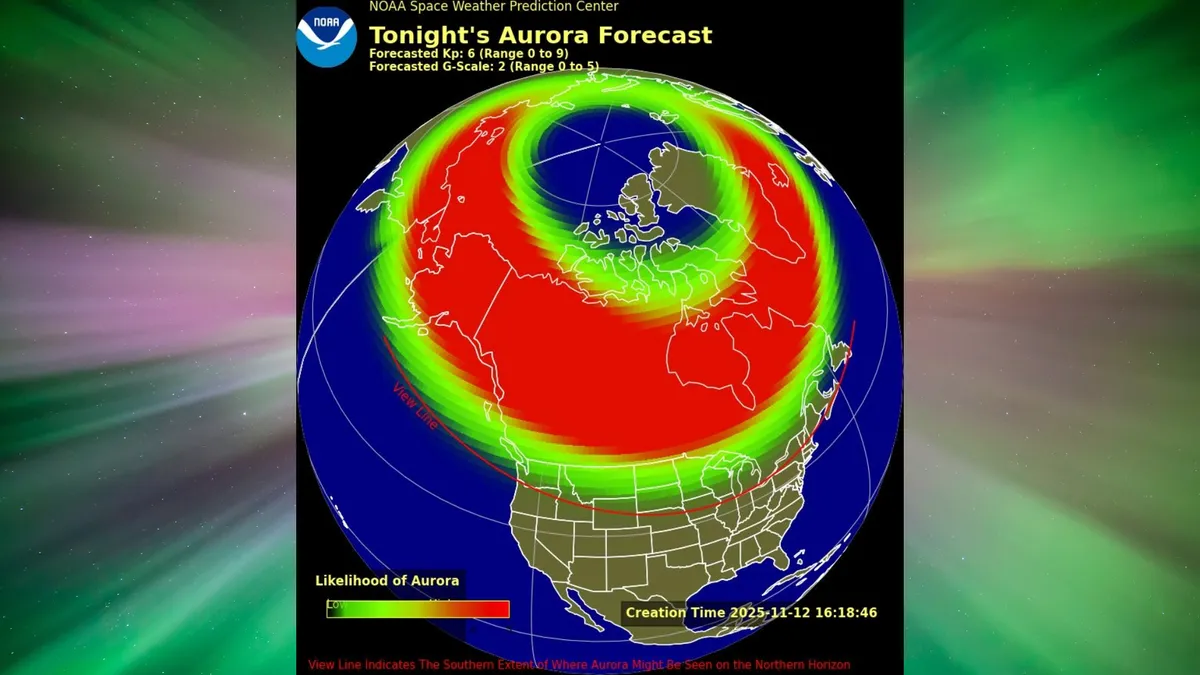
The impact on our planet is evidenced by the extreme southern extent of what scientists are calling Aurora Bovinalis.

Last November’s Northern Lights. Image: NOAA Space Weather Prediction Center
Methane: the Silent Killer

Methane, conveniently covalently bonded. Image: Wikipedia

Methane, or as scientists like to call it, carbon tetrahydride, is a tetrahedral molecule with four equivalent C-H bonds. But that’s just oversimplifying the molecular makeup of this silent but deadly killer. It’s a Group-14 hydride, the simplest alkane. It’s the main constituent of natural gas.
Methane may be called “natural gas,” but how natural is it if it’s destroying the atmosphere of the surface of the Sun? It’s an invisible, colorless gas. While ‘technically’ odorless, when combined with feculent material… I would not advise standing near the south end of a corn-fed cow.
Methane, at very long distances, absorbs visible light at the red end of the spectrum. This gives Uranus its blue or bluish-green color as light passes through its methane-rich atmosphere and is scattered back to Earth. But I don’t need to tell you what else comes from Uranus.
Cattle: Meat or Murderers?

Cow, aka Bos taurus (not his real name). Image: Wikipedia

Methanogenesis is an anaerobic process in which this domesticated four-hooved cud-chewing furnace magically converts feed into fermented fumes. The equation for mankind is simple: sirloin or survival, hot dogs or health? Do you want to risk it for brisket?
We have to beef up our concern about these cuddly cattle killers, or we’ll surely steer ourselves to an Artiodactyl Armageddon. Look at that CME pictured at the top – the resemblance to a pillar of fire is unmistakable.
What Can Be Done?
Denmark is moving ahead with the world’s first carbon tax on agriculture, charging cattle farmers almost €100 per year for each cow’s greenhouse gas emissions. But is that enough?
After extensive research at Wind Break Laboratories, the latest data dump studied by the renowned scientific community – Fellowship of Astronomical Research Theorists – has determined the best solution to methane multiplication and its concomitant coronal mass ejections. Move as far away from the Sun as possible.

Pluto (actual size). Image: Wikipedia

In our Solar System, this would involve relocating to Pluto, that astronomical object named after Mickey Mouse’s dog. Because it was downgraded and is no longer considered a planet, real estate values have plummeted, and you can get a lovely little ranch house for a song.
- The upside: Earth is only 8.3 light-minutes from the Sun, while light takes 5.5 hours to reach Pluto.
- The downside: it would take about 9.5 years to get there with current technology, and there’s no oxygen.
The next-best solution is to stop feeding cattle methanogenic feed. They convert grass to gas. Let’s turn that grass into lawns. Or we could give cattle a surfactant like simethicone, which reduces bloating and gas.
Alternatively, we could feed them Soylent Green, food that is “as good as humanly possible.”
Bill Petro, your friendly neighborhood hysterian
billpetro.com

Hilarious!