History of Coffee: International Coffee Day

Coffee. Image: Neuroscience News

HISTORY OF COFFEE: INTERNATIONAL COFFEE DAY
Yesterday, September 29, was National Coffee Day in the US and 16 other countries.
But tomorrow, October 1, is International Coffee Day, also known as National Coffee Day in 12 countries.
Whether percolated, filtered, steeped in a French press, poured over, or made with high-pressure steam in an espresso maker – at 10 to 15 times the quantity of coffee-to-water as gravity-brewing – 90% of humans ingest this caffeinated beverage regularly, making it the most widely used psychoactive drug and capturing the imagination of people the world over.
The world drinks a little over two billion cups of coffee every day, and 125 million people depend on it for their livelihoods. About two-thirds of adults drink coffee daily, and the average coffee drinker has about three cups a day.
History of Coffee Day
It was first declared International Coffee Day in Milan, Italy, at Expo 2015 on October 1, 2015, following a decision by the International Coffee Organization the previous year. Expo 2015 was a World Expo focusing on “Feeding the Planet, Energy for Life,” where the Italian companies Illy and Lavazza sponsored coffee.

EXPO 2015 opening, Milan. Image: Ongreening.com

However, other Coffee Day events had occurred in the decades preceding it, including:
- Japan: The All Japan Coffee Association.
- US: National Coffee Day was first observed in 2005. The Southern Food and Beverage Museum held a press conference about International Coffee Day as part of the New Orleans Coffee Festival.
- China: It was first celebrated through the International Coffee Organization in 1997 and became an annual event in April 2001.
So it isn’t easy to ascertain exactly when the coffee day was born.
Coffee: Legal Addictive Stimulant

Tom Hanks at a Starbucks coffee shop on the Upper West Side of New York in the film “You’ve Got Mail” (Warner Bros., 1998). Image: Thrillist

Tom Hanks, as the character Joe Fox in the movie “You’ve Got Mail,” talks about Fox Bookstores that sell
“cheap books and legal addictive stimulants.”
While coffee is now legal and provided for free in many workplaces and churches, it was not always permitted in the Roman Catholic Church, the Orthodox Church, or Islam. But first, some history of coffee itself.
History of Coffee
The etymology of the word may give us clues. Originally, the Arabic word qahwah was a noun for a type of wine; the verb form qaha meant “to lack hunger,” perhaps referring to coffee’s appetite-suppressing quality. Kaffa refers to a kingdom in medieval Ethiopia where the coffee plant may have been exported to Arabia. The feminine form of the Semitic qhh is qahwah, meaning “dark in color, dry, sour.”
The origin of coffee is shrouded in legend. It dates back to the mid-9th century or earlier, but it’s hard to document. We do know that in the early 15th century, Sufi monasteries in Yemen knew of it as an aid to concentration and to keep awake for nightly devotions, and it spread to Mecca and Medina.
Mocha became the main port for coffee traders to transport coffee from the Yemeni mountains. By 1414, the beverage was known in Mecca and spread to Egypt and North Africa.
It spread north to the Middle East and Turkey by the end of the century. By the 1550s, coffee had reached Constantinople, which is now Istanbul, the capital of the Ottoman Empire. In 1570, there were more than 600 coffeehouses in Constantinople alone.
It traveled east to Persia and South India and west to northern Africa. From there, it spread north to Italy, the Balkans, the rest of Europe, and Southeast Asia. From Europe, the Dutch shipped it to the East Indies and the New World, in Central and Southern America. Brazil, where coffee arrived in the 19th century, now produces about 40% of the world’s coffee.

The Spread of Coffee. Image: Radio Free Thinker

Coffee in Eastern Religions
In Islamic lands, particularly in Mecca, it was forbidden in 1511 due to its stimulating effect, as decreed by conservative, orthodox imams at a theological court there. However, by 1524, the Ottoman Turkish Sultan Suleiman I issued a fatwa that removed it from the list of haram (forbidden) items, thereby allowing the consumption of coffee.
In the Ethiopian Orthodox Church, it was banned before the 18th century, but it became widely consumed in the 1880s after Emperor Menelik of Ethiopia drank it.
Ironically, the caffeine in coffee is actually a suppressant. It acts as an inhibitory process that keeps you awake by shutting down the signals that tell you to sleep. Caffeine blocks adenosine, the molecule the brain builds up throughout the day to make you feel tired. So caffeine doesn’t give you energy. It just quietly removes the signal that tells you you’ve run out of it.
Coffee in Europe
Hungary
Coffee arrived in Europe in the early 16th century, initially in Hungary, during the Battle of Mohács in 1526, fought against the Ottoman Turks.
Last year I had coffee in Budapest, Hungary, at the Párisi Passage Cafe & Restaurant in the luxury Párisi Udvar Hotel, just off the River Danube.

Párisi Udvar Hotel Budapest. Author’s photo
While the venue is stunning, the confections you can order with your coffee look like little green men from outer space; they’re out of this world.

Confection at Párisi Passage Cafe & Restaurant. Author’s photo
Coffee quickly moved to Austria within a year. It was popularized throughout the Habsburg Empire, including cities such as Vienna, Austria.
Austria
Coffeehouses in Austria date back to the Battle of Vienna in 1683, when the Ottoman Turks were defeated in their westward march into Europe. The spoils of that defeat were coffee beans. Sugar and milk were added to the coffee brew. One style of drink, made from foamed milk and a glass of water, similar to today’s cappuccino, is called Wiener Melange or Vienna Mixture… shades of the science fiction novel/film Dune!
Vienna is fairly festooned with coffeehouses. And the pastries! I visited Demel, a 240-year-old pastry shop and chocolaterie in Vienna, a “Purveyor to the Imperial and Royal Court,” located near the imperial (Holy Roman Empire) Hofburg Palace. They serve a famous chocolate tart called Sacher-Torte, a chocolate sponge cake covered with chocolate glaze with an interior layer of apricot jam. It is to die for… or from.

Sacher-Torte, at Demel, Vienna. Author’s photo
And the coffee you order to accompany this divine confection is served with liqueurs such as amaretto, cherry schnapps, or orange liqueur. And of course, mit Schlag, with whipped cream.

Franziskaner, a melange with whipped cream & chocolate sprinkles at Demel, Vienna. Author’s photo
Historical Trivia:
“Cappuccino” came from the Viennese Kapuziner coffee, but was developed in and spread across Italian-speaking parts of the northern Italian empire. The name comes from the color of the habits worn by Capuchin friars.
Italy
The coffee culture is expressed in Italian; most varieties of coffee drinks have Italian names. There are about 20 types of coffee drinks in Italy today.
Try this when you order at one of the 41,000 Starbucks stores around the world:
Ask the barista what their largest size “vente” means. You’ll usually get an answer like “large” or “big.” It actually is Italian for “twenty” as in a 20-ounce cup.
In 1580, Prospero Alpini, a Venetian botanist and physician, imported coffee into the Republic of Venice from Egypt. The first coffeehouses appeared in the city in 1629. By 1763, Venice had more than 200 coffee shops. The main coffee port is Trieste, home of the coffee processing industry. Italian coffee consumption is highest there, with an average of 1,500 cups of coffee per person per year, twice the national average.
In the first half of the twentieth century, Italians began experimenting with machines that used steam pressure to brew coffee more quickly, so they could serve it in commercial establishments. Steam-based coffee machines produce so-called espresso because it is delivered much more quickly than other methods. The espresso machine is built for speed: hot steam is forced through finely ground coffee, fast enough for someone to order at a counter, drink, and get on with their day. Steam is hotter than boiling water and can extract more coffee essence than water used in percolation. It also produces crema, that thin gold foam on top, as a byproduct of pressure.
Italians developed a coffee drink called Caffeè Americano because U.S. soldiers stationed there during World War II found the flavor of espresso too intense compared to the drip coffee they were used to back home. So they added hot water to dilute the coffee drink.
Netherlands

The French Coffee house Koffiehuis in the Kalverstraat, Amsterdam, a century later, circa 1761, by Isaac Lodewijk la Fargue van Nieuwland (1761).Image: Stadsarchief Amsterdam (25-09-2024). Image: University of Amsterdam
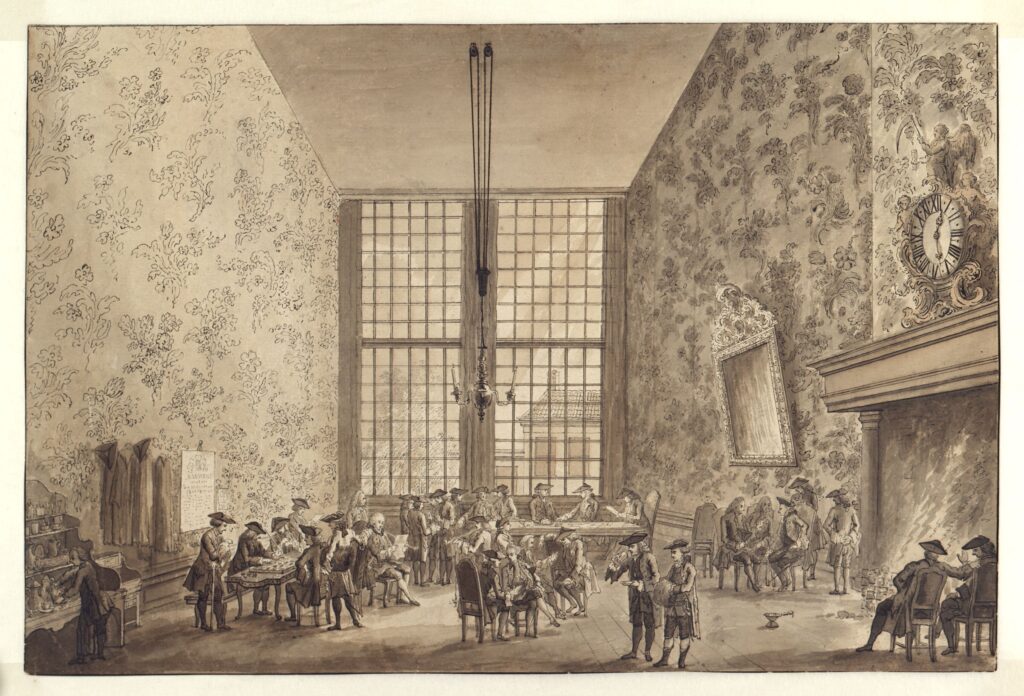
In 1663, the first coffee house in the Netherlands opened in Amsterdam, featuring a seating area, a couch, a buffet, and a serving table. Shipped to Europe by the Dutch East India Company (VOC) from the Islamic world, it was called “cauwe” rather than the modern “koffie.” European travelers described it as “black as ink.”
France

Café Procope, Paris. Author’s photo
In France, coffee beans came via the ambassador from Sultan Mehmed IV of the Ottoman Empire in 1669. The first continuous coffeehouse, where they even mixed coffee with chocolate, was Café Procope, established in Paris in 1686, as I discussed earlier.
The 19th-century French historian and author Jules Michelet wrote:
“Coffee, the sober drink, the mighty nourishment of the brain, which unlike other spirits, heightens purity and lucidity; coffee, which clears the clouds of the imagination and their gloomy weight; which illumines the reality of things suddenly with the flash of truth.”
England
In England, the first coffeehouse opened in Cornhill, London, coffee having arrived no later than the 16th century.
Jonathan’s Coffee-House, established in 1698, was where stocks and shares were traded and eventually evolved into the London Stock Exchange.
Lloyd’s Coffee House was the venue where merchants and shippers discussed insurance arrangements, leading to the establishment of Lloyd’s of London.
There were thousands of coffeehouses in London; at their peak, one for every 200 Londoners.

Queen’s Lane Coffee House, Oxford. Author’s photo
Perhaps the most famous coffeehouse was Queen’s Lane Coffee House, which opened in Oxford in 1654 and remains open today.
Coffee cost a penny back then, but the information there, through newspapers, books, magazines, and conversation, was free. Coffeehouses were often referred to as “penny universities.”
Coffee in the Americas
Latin America
Coffee first arrived in Martinique, in the Caribbean, in 1720. From plantations there, it spread to Haiti, Mexico, and other Caribbean islands. From there, it spread to South American countries like Brazil and French Guiana. Brazil became the world’s largest producer of coffee beans by the mid-19th century. It also spread to Central America, including Guatemala and Costa Rica.
North America
The 1773 “Boston Tea Party” led to tea drinking being seen as unpatriotic, and coffee drinking soared. Coffee had been available since 1670, when Dorothy Jones was the first coffee licensee. Coffee thirty years earlier was in New Amsterdam (New York City). The famous London Coffee House opened in 1689 but was renamed The American Coffee House with the arrival of the American Revolution in the 1770s.
Coffeehouses: “Dens of Dissent”

17th-century London Coffeehouse. Image: Wikipedia
During the Enlightenment, these early English coffeehouses became gathering places for deep religious and political discussions among the populace. This practice became so familiar, and potentially subversive, that King Charles II of England attempted to suppress coffeehouses in 1675. However, the king’s war against coffee lasted only 11 days because the public openly ignored his ban. He canceled it two weeks before it was to go into effect “out of princely consideration and royal compassion.”
The aforementioned Café Procope in Paris hosted not only the artistic and literary community, like Victor Hugo, Voltaire, and Balzac – it was the birthplace of the Encyclopédie, initially conceived by Denis Diderot – but back in the 18th century, such revolutionaries as the French Robespierre, the American Ben Franklin, and a young Napoleon Bonaparte.
Initially, Boston coffeehouses were
“generally meeting places of those who were conservative in their views regarding church and state, being friends of the ruling administration. Such persons were terms ‘Courtiers’ by their adversaries, the Dissenters and Republicans.”

Green Dragon Tavern and Coffee House
However, the Boston coffeehouse and tavern, the Green Dragon, built in 1701, was known as the “Headquarters of the American Revolution” because of the meetings held in its basement.
St. Andrew’s Lodge of Freemasons, including Paul Revere, bought the tavern in 1764, and the “Sons of Liberty” began meeting there. The Masons met on the first floor. The coffeehouse was also used as a meeting space for business, politics, theatre, concerts, exhibitions, and other secular activities. Some even suggest that parts of the Boston Tea Party were planned there.
According to Daniel Webster, this tavern played a role in nearly all important national affairs from 1697 to 1832, thereby earning the title “headquarters of the Revolution.”
Incidentally, George Washington was one of the first farmers to experiment with growing coffee in Virginia.
Coffee on Trial: “Devil’s Drink”

Pope Clement VII, age 48, by Sebastiano del Piombo, 1526. Image: Wikipedia

A popular, perhaps legendary, story told by coffee aficionados about Pope Clement VIII.
Historical trivia:
This is the same Pope who refused to give Henry VIII of England annulment for his marriage to Queen Catherine of Aragon, triggering the English Reformation.
Clement was pressured by his advisers in 1600 to denounce coffee because of its association with Islam and its curious effects on drinkers. They called coffee a “bitter invention of Satan.” They claimed, “the drink would corrupt their congregations with its great tasting bedevilment.”
But Clement needed to investigate this Italian addiction further. After tasting a hot cup of joe, he reportedly commented:
“Why, this Satan’s drink is so delicious that it would be a pity to let the infidels have exclusive use of it.” – Pope Clement VIII, reportedly
The story goes that he then blessed coffee beans and suggested that it would be better for people to drink it than alcohol.
Coffee: It’s Not Just for Breakfast Anymore
The first espresso coffeehouse on the West Coast of the US, Caffé Trieste, has been a San Francisco landmark since 1956. I visited there a few years ago, where musicians have been performing for years, especially since the Bohemian (Beatnik) days of North Beach, the predominantly Italian neighborhood in San Francisco.

Caffe Trieste, North Beach, San Francisco. Author’s photo
From the late eighties to the early nineties, international coffee shop chains became popular, the most obvious one being Starbucks, which used those Italian beverages to relaunch coffee houses by charging a premium for products that were difficult to make at home. I have an espresso machine that I use every morning.
Coffee Growing Regions
Today, the three leading exporters of coffee are:
- Brasil,
- Vietnam
- Columbia
Coffee is currently grown between the Tropics of Capricorn and Cancer, where there is rich soil, mild temperatures, ample rainfall, and shade, preferably at higher altitudes. It’s grown in fifty countries worldwide.

The Story of Coffee — Google Arts and Culture
Coffee for the Contemporary Barista
A modern barista might concoct a variety of coffees. Some start with espresso and varying amounts of milk or water:


The Story of Coffee — Google Arts and Culture
There are numerous fancy coffee drink variations, including those with steamed milk or whipped cream. You can add ice, liquor, or cinnamon.
My favorite is a Mocha with espresso, Ghirardelli chocolate, steamed milk, and whipped cream. But I especially like it without whipped cream and “latte art” instead.

Latte art. Author’s photo
Coffee: By Any Other Name

Plan of the City of Mocha. Image: ResearchGate.net
Mocha is a city in Yemen, and also the name for “coffee (espresso) with chocolate.”

Original Java logo. Source: Sun Microsystems
Java is a city in Indonesia where coffee was planted, and it is also a nickname for coffee. It is also the name of a popular programming language originally from Sun Microsystems.
Developed by James Gosling and others at Sun Labs, it was initially called “Oak” after a tree outside the Labs. I was a product manager at Sun in the mid-90s, and I called my fellow product manager, Kim Polese, who managed Java, and asked her why the name changed from Oak to Java. She told me
“We wanted something that captured the idea of energy and movement.”
In Praise of Coffee

Johann Sebastian Bach: Schweigt stille, plaudert nicht. Image: Discogs
During the early part of the 1730s, Johann Sebastian Bach composed in Leipzig his Schweigt stille, plaudert nicht, known as the “Coffee Cantata,” where a young lady extols the virtues of the new fashion, coffee drinking, to her disapproving father:
Oh! How sweet coffee does taste,
Better than a thousand kisses,
Milder than muscat wine.
Coffee, coffee, I’ve got to have it,
And if someone wants to perk me up,
Oh, just give me a cup of coffee!
Bill Petro, your friendly neighborhood historian
billpetro.com

Bob Newheart had a hilarious bit about Sir Walter Raleigh reporting to the king about his discoveries in the new world, The bit about coffee is priceless.