History of Independence Day: Was the Declaration of Independence really signed on July 4, 1776?

Declaration of Independence. Image: Harvard
HISTORY OF INDEPENDENCE DAY
Part of the series on America 250, the US Semiquincentennial


[In my previous article, I wrote about Thomas Jefferson, a man of paradox: liberty-loving slaveholder, Indian-loving relocationist, publicly frugal and privately bankrupt, a constitutional conservative who bought the Louisiana Territory in 1803.]
Independence Day, also known as the Fourth of July, celebrates the adoption by the Continental Congress on July 4, 1776, of the Declaration of Independence, which proclaimed the severance of the American colonies’ allegiance to Great Britain. It is the most significant secular holiday in the United States, observed in all the states, territories, and dependencies.
Was it really signed on July 4, 1776? Who created it, and how was it approved and celebrated? What is the enduring significance of the Declaration of Independence?
Although it is assumed that the Second Continental Congress unanimously signed the document on the 4th of July, not all delegates were present, and there were no signers at all, contrary to the theatrical musical 1776. Here is what really happened.
Resolution for the Declaration of Independence
The congressional delegate from Virginia, Richard Henry Lee, introduced a resolution in the Continental Congress on June 7, 1776:
“that…body declare the United Colonies free and independent States, absolved from allegiance to or dependence on the Crown or Parliament of Great Britain…”
Committee of Five on the Declaration of Independence

Committee of Five. Image: Fine Art America

On June 10, a Committee of Five featuring Thomas Jefferson (the actual scribe) was appointed to prepare a declaration suitable to the occasion if the Virginia resolution was adopted. Benjamin Franklin and John Adams revised Jefferson’s version before it was sent to Congress, where they made some additional edits of their own.
The other committee members were Robert R. Livingston of New York and Roger Sherman of Connecticut. Congress also removed a long section Jefferson had penned condemning King George III for inflicting the slave trade on America. This is somewhat ironic, considering Jefferson was the second-largest holder of slaves in his county.
Approval of the Declaration of Independence
Congress approved the resolution on July 2; the Declaration, composed by Jefferson and amended by his Committee, was adopted on July 4. That evening, John Hancock ordered Philadelphia printer John Dunlap to print 200 broadside copies of the agreed-upon Declaration that he signed as President and Charles Thomson as Secretary.
These were distributed to members of Congress and the 13 colonies, as well as elsewhere. The Declaration was read in the yard of the statehouse on July 8. New York did not even vote on it until July 9. The signing was even more gradual, and it is partially misleading to speak of the “fifty-six original signers of the Declaration of Independence.”
By August 6, most of those whose names were on the document had signed, but at least six signatures were attached later. One signer, Thomas McKean, did not sign until 1781! Some of those who signed were not even in Congress when the Declaration was adopted, and some who voted for it in Congress never got around to signing it.
Robert R. Livingston was one of the five original committee members. He helped frame the document and voted for it, but never signed it.
The Founding Fathers recognized the gravity of signing this document. John Adams said, on July 3, 1776:
I am well aware of the toil and blood and treasure that it will cost us to maintain this Declaration.”
Celebration of Independence Day
The first anniversary of the Declaration was observed only in Philadelphia, PA, by the adjournment of Congress, a ceremonial dinner, bonfires, the ringing of bells, and fireworks.
In 1788, after the requisite number of states had adopted the Constitution, Philadelphia celebrated July 4 with elaborate festivities, including a grand procession. It has been a tradition to celebrate it on July 4th, despite other dates of completion, largely because that is the date on the document.
Recognition of the Declaration of Independence

Treaty of Paris. Image: Wikipedia
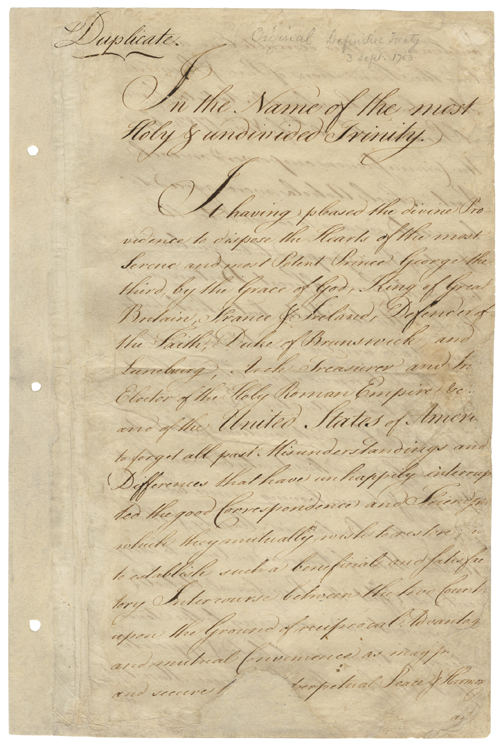
However, it was not until September 3, 1783, that major European countries recognized the end of the American Revolutionary War. The Treaty of Paris was signed between the British and the U.S. at the Hotel d’York in Paris.
The Peace of Paris (or the Treaties of Versailles) recognized the end of the American Revolutionary War, among other European issues. It was signed by the representatives of King George III of England and of King Louis XVI of France, King Charles III of Spain, and the States-General of the Dutch Republic.
Observance of Independence Day
Boston, Massachusetts, first observed the day in 1783, and subsequently this celebration replaced the commemoration of the Boston Massacre on March 5. The custom spread to other cities and states, where parades, patriotic oratory, military displays, and fireworks marked the day.
Today, games and athletic contests, picnics, patriotic programs and pageants, and community fireworks of pyrotechnic expertise are characteristic of the 4th of July.
Similarly, so too are attending baseball games, flying the American flag, consuming hot dogs, and imbibing inebriating fluids.
Hollywood Tie-in to Independence Day
Several years ago, the actress Reese Witherspoon recorded a tribute to the Declaration of Independence document when a lost copy was discovered, folded between the canvas and frame of a picture. This audiovisual presentation accompanied the document on a nationwide road trip. This was one of John Dunlap’s original 200 broadsides.
Why did she do this? She claims she is a descendant of John Witherspoon, the only active clergyman to sign the Declaration of Independence. He himself is a descendant of John Knox, the Scottish Reformer who studied under the Reformer John Calvin in Geneva.
Significance of the Declaration of Independence
Many have marveled at one line in the Declaration of Independence:
“We hold these truths to be self-evident, that all men are created equal, that they are endowed by their Creator with certain unalienable Rights, that among these are Life, Liberty and the pursuit of Happiness.”

American Scripture, by Pauline Maier. Image: Amazon
In a secular sense, it’s the epitome of American Scripture. Indeed, nearly three decades ago, the historian Pauline Maier wrote a book by that name on the history of the Declaration of Independence’s meaning and development.
Last year, Walter Isaacson wrote the slim 67-page The Greatest Sentence Ever Written on that one line in the Declaration of Independence.
The line has inspired not only Americans, but people around the world. In its religious framing, it was deliberately non-sectarian. It was theistic, to be sure, but was acceptable to any denomination or religion. It asserted that there are rights that are pre-political and above any government.
But equality itself was aspirational. Basic political and civil rights were denied to women, enslaved people, and Native Americans. It would take amendments to the U.S. Constitution to legally establish that right:
- 13th (1865, abolishing slavery)
- 14th (1868, equal citizenship)
- 15th (1870, voting rights regardless of race)
- 19th (1920, women’s suffrage)
- 24th (1964, eliminating poll taxes)
It took a Civil War to secure slaves’ freedom, and the Civil Rights movement of the mid-1960s to win African Americans’ civil and voting rights.
Personal Reflection
The sentence doesn’t guarantee an easy journey or a complete resolution. Instead, it points in a direction — toward a world where every person’s God-given dignity is acknowledged and safeguarded. For those who believe that all human beings are created in the image of their Creator, it transcends being a mere political statement; it’s a moral imperative that remains unanswered. Perhaps that’s the intention: it wasn’t written to depict the world as it is, but to beckon us toward the world we should strive to create.
Martin Luther King Jr. referred to this sentence as:
“a promissory note to which every American was to fall heir.”
Bill Petro, your friendly neighborhood historian
billpetro.com
Podcast:

This was so helpful for my history project
I recently read that the meeting to approve Jefferson’s document was plagued by nitpicking but that the vote to accept it and adjourn happened early because Independence Hall had a cloud of horseflies from a nearby stable. The day had been hot and the windows were opened.
John,
I’m not familiar with that story. However, when I was in Paris 2 years ago, going to my favorite museum, Musee D’Orsay, I noticed for the first time (as it has only been there 8 years) a statue nearby of Thomas Jefferson. But he was not facing the Musee. Read the article again to find out what he was facing.
-Bill