History of Mole Day: Avogadro’s Number, 10^23

HISTORY OF MOLE DAY: AVOGADRO’S NUMBER
Today, October 23, at 6:02 a.m., Mole Day begins. As a geek holiday, it is based on something you may remember from high school chemistry:
Avogadro’s Number: 6.02 x 10²³
Or, in full, it’s 602,214,076,000,000,000,000,000.
What better reason to celebrate Mole Day than 6:02 am on 10/23?
What’s a Mole, and who came up with it?
A mole is that number of things, like a dozen, but much larger. Because a mole of baseballs would cover the Earth well over a hundred miles deep, it’s better to use “mole” to talk about atoms or molecules. (By the way, Wilhelm Ostwald coined “mole” (from the German word for molecule: Molekül) in the 1890s.)
Who was Avogadro?

Amedeo Avogadro. Image: Wikimedia
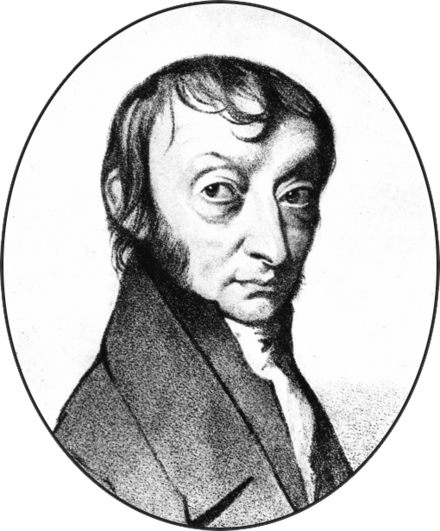
Lorenzo Romano Amedeo Carlo Avogadro, Count of Quaregna and Cerreto, known to his friends as Amedeo Avogadro, was born in Turin in 1776, the same year as the American Declaration of Independence. This period marked a renaissance in chemistry; the 1770s-90s are known as the Chemical Revolution.
Contemporary French chemist Joseph Louis Gay-Lussac was experimenting with combining volumes, which intrigued Avogadro. Gay-Lussac developed a law stating that when two gas volumes react to form a third gas, the ratio of the reactants’ volumes to the product’s volume is a simple whole number.

Two volumes of Hydrogen gas combine with one volume of Oxygen to form two volumes of water vapor. Image: Quantum Freak
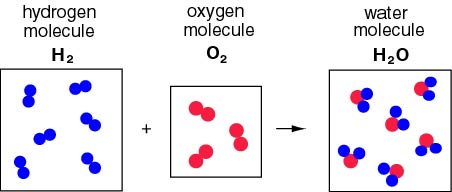
In other words:
2H2 + O2 ==> 2H2O
It’s simple stoichiometry.
Avogadro’s Big Idea
This is where Avogadro’s genius came in: for the law to hold, he hypothesized that at the same temperature and pressure, equal volumes of the two reactants (indeed, any gases) have equal numbers of particles. Avogadro’s problem was that the words and categories for molecules did not yet exist. Avogadro’s leap was realizing that hydrogen and oxygen both travel in pairs, H₂ and O₂, which is the only way the volumes add up.

Stanislao Cannizzaro. Image: Wikipedia

Fortunately, Sicilian chemist Stanislao Cannizzaro (1826-1910) brought Avogadro’s Law to prominence, even though Avogadro had died four years earlier. In 1961, chemists settled on defining the atomic mass unit as exactly 1/12 the mass of a Carbon-12 atom.

Carbon-12. Image: Fity Club
This common Carbon isotope has 6 protons, 6 neutrons, and 6 electrons. Since electrons have negligible mass, 1/12 (one-twelfth of the atom’s 12 nucleons) of a Carbon-12 atom is very close to the mass of just a single proton or neutron.
Still with me?
Atomic weights of isotopes, like Carbon-12, are expressed in atomic mass units. Hydrogen has an atomic weight of 1.008 amu. (Since 2005, this measurement has been updated to the dalton (Da), or just “u”.)
Chemists created a relationship between the amu and the gram, which looks like this:
1 amu = 1/(6.02214076 x 1023) grams
So, with a mole, or an Avogadro’s number of Carbon-12 atoms, we’d have exactly 12 grams. Jean Perrin named it “Avogadro’s number” in 1909. His measurement of it contributed to his 1926 Nobel Prize. Now chemists can use this equation to convert between measurable grams and invisible atoms. This resulting number is named in honor of Avogadro.

Who is Promoting this Holiday?

Coffee in an Erlenmeyer flask
The esteemed American Chemical Society has a dedicated Mole Day site. They also share Mole Day jokes, like “Finding NeMole,” sing a song about Mole Day, and make coffee in their Erlenmeyer flasks.
Chemistry Trivia:
The Chemex coffee maker was invented in 1941 by chemist Peter Schlumbohm, essentially an Erlenmeyer flask married to a funnel
In high school, I won my school’s American Chemical Society Chemistry Award. Chemistry was my major at University, before I switched to history.
Can You Eat a Mole?
There’s a Mexican sauce called mole, though I’d recommend against serving it on the Eulipotyphla mammal of the same name. There is, however, a popular restaurant-bar-music venue in Fort Collins, Colorado, called Avogadro’s Number. You can add fresh avocado to almost anything on the menu.

Bill Petro, your friendly neighborhood historian
billpetro.com
