History of New Year’s Eve
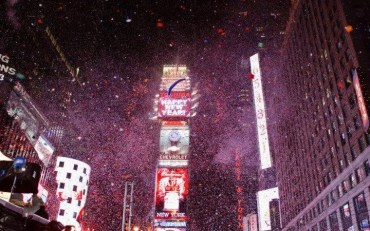
Times Square, New York City
HISTORY OF NEW YEAR’S EVE

New Year’s Eve, according to the Gregorian Calendar, is the last day of the year, known as Old Year’s Day or St. Sylvester’s Day.
You may remember reading that Emperor Constantine was considered the first “Christian” Roman Emperor. St. Sylvester, the Bishop of Rome, baptized Constantine in the 4th century.
New Year and Astronomy
As I describe here, New Year’s celebrations go back before the Romans to Mesopotamia about 2,000 years B.C. However, those celebrations occurred during the Vernal Equinox in March and, during Roman times – two millennia later – were moved to January.
This was done at the recommendation of Sosigenes of Alexandria, an ancient astronomer who convinced Julius Caesar to reform the calendar to a solar one like that of the Ptolemaic Egyptians, rather than the previous lunar calendar Rome had been using since the 7th century B.C. Caesar did this by introducing the Julian Calendar in 46 B.C.
Astronomically speaking, Earth is always closest to the sun in its yearly orbit around this time. This event is called Earth’s perihelion.

Earth’s perihelion
American New Year’s Eve
In the U.S., the featured event of the New Year’s Eve celebration is the “dropping of the ball” in New York City’s Times Square at midnight, which marks the transition from December 31 to January 1 of the New Year. Times Square became the site in 1904, where the New York Times Building was situated. There were chiming bells, fireworks, and… falling hot ash.
The Times’ publisher asked Walter Palmer, the Times’ chief electrician, to develop an alternative. Since 1829 in Portsmouth, England, and since 1845 in Washington, D.C.’s Foggy Bottom, a maritime “time ball” was dropped so that sailors at sea could observe it with a telescope and synchronize their chronometers.

N.Y. Times Building, 1907
Palmer designed the same system using electricity from atop the New York Times Building at 46th St and Broadway, beginning in 1907, and it has continued annually, except in 1942 and 1943, when blackouts due to World War II canceled festivities.
New York Times Square Ball

The Ball
Today, in its seventh iteration, the “Times Square Ball” system is 12.5 feet in diameter, weighs 12,300 pounds, and uses 5,280 circular Waterford Crystal panels.
It begins its descent at 11:59 PM on December 31. Everyone counts down together to the New Year.
American Declaration of the Ending of Slavery
There was a unique New Year’s celebration amongst the American enslaved population associated with President Lincoln announcing that he would make effective the Emancipation Proclamation on January 1, 1863, declaring
“that all persons held as slaves” [within the rebellious states] “are, and henceforward shall be free.”
New Year’s Eve Tradition: Midnight Kissing
New Year’s Eve is often associated with parties, and the tradition of quadrilabial osculation at midnight originated in the British practice of “saining,” a Scots word for blessing or protection, observed during the Yuletide period.
It was thought to bring good luck. No mistletoe is required.
New Year’s Eve Tradition: Drinking Bubbles
Popping the cork of champagne or sparkling wine bottles is popular today, but “bubbly” goes back centuries. We can trace the development of carbonated wine back to 16th-century England, but it was the French who popularized it.
What we’ve called Méthode champenoise since the 19th century involves an added “dosage” of sugar for a second fermentation. Christopher Merret reported to the Royal Society of London in 1662 that adding sugar to bottled wine created a fizzy beverage, thanks to the yeast in the wine, which consumed the sugar to produce carbon dioxide. The French perfected it in a region known as Champagne.

Reims Cathedral today
In 496 A.D., they used wine from the Champagne region of France to baptize Clovis, the first king of the Franks. This occurred at the Reims Cathedral, where French kings have been crowned for centuries.
Reims is one of the principal cities of the Champagne region. It is home to many Maisons de Champagne, which are the largest champagne-producing houses. I have visited two champagne houses there: Taittinger and Veuve Clicquot.

By the way, during World War II, Reims was the headquarters of the Supreme Headquarters Allied Expeditionary Force and the location of the unconditional surrender of the German Wehrmacht on May 7, 1945… V-E Day.
Wine Snobbery You Can Use
Do you know wine snobs who pronounce French wines with a condescending, nose-in-the-air French accent? Here’s your chance to one-up them:
Moët & Chandon is another premium wine house in the Champagne region. Some New Year’s Eve party snobs will pronounce Moët with a knowing “MoAY” declaring that it’s because the trailing “t” is silent in French. But there’s a rule that supersedes it: one always pronounces the “t” at the end of a word ahead of a vowel. The “&” is actually “et” (and) in French or Moët et Chandon, so it still should be pronounced “Moët et Chandon.”
There is a more interesting origin story: French winemaker Claude Moët‘s name was Dutch and the Dutch pronounce their “t.” But it’s harder to illustrate and no one is going to listen long enough to your explanation that a Dutch soldier named LeClerc fought alongside Joan of Arc who was fending off English efforts to prevent Charles VII from being crowned king of France such that in gratitude, the king changed the soldier’s name to Moët. But they’ll think you’re a history expert and a wine connoisseur. Even more so, if you mention that they produce Dom Pérignon.

New Year’s Eve Tradition: Singing Auld Lang Syne
In 1929, the musician Guy Lombardo played this old Scottish song at a hotel in New York, and it became an American tradition via radio broadcast and then TV in 1956. You can read about its origin and meaning here.
New Year’s Eve Tradition: Religious Services
Catholic and Protestant churches hold a “Watch Night” service that extends past midnight on New Year’s Eve. The founder of Methodism, John Wesley, learned it from the Moravian Brethren in the 1730s.
Presbyterians, who trace their roots to Scotland, observe the traditional Hogmanay by singing hymns of thanksgiving for God’s blessing for the year.
New Year’s in Austria

The Vienna Philharmonic Orchestra performs its traditional concert in the beautiful Golden Hall of the Musikverein in Vienna. Image: BBC
At midnight on New Year’s Eve in Vienna, Austria, the “Pummerin” – the largest bell in St. Stephen’s Cathedral – rings out, and the Blue Danube Waltz by Johannes Strauss II begins to play.
Each year, the Vienna Philharmonic Orchestra’s New Year’s Day concert is broadcast to over 90 countries and 50 million viewers. And so the year turns in three-four time.
How do you celebrate New Year’s Eve?
Bill Petro, your friendly neighborhood historian
billpetro.com
