History of Thanksgiving Native American: Why Squanto already knew English

Detail of illustration depicting Native American Squanto. Image: Kean Collection/Archive Photos/Getty Images
HISTORY OF THANKSGIVING: FRIENDLY NATIVE AMERICAN?

We’ve all heard the story of how the Pilgrims, landing in Massachusetts on the Mayflower in 1620, were ill-equipped to survive the harsh winters of the New World.
We’ve also heard how they met a Native American of the Pawtuxet tribe named Squanto, who befriended them, taught them how to survive in their new wilderness home, showed them how to plant and fertilize their crops, fish, and hunt deer and beaver.
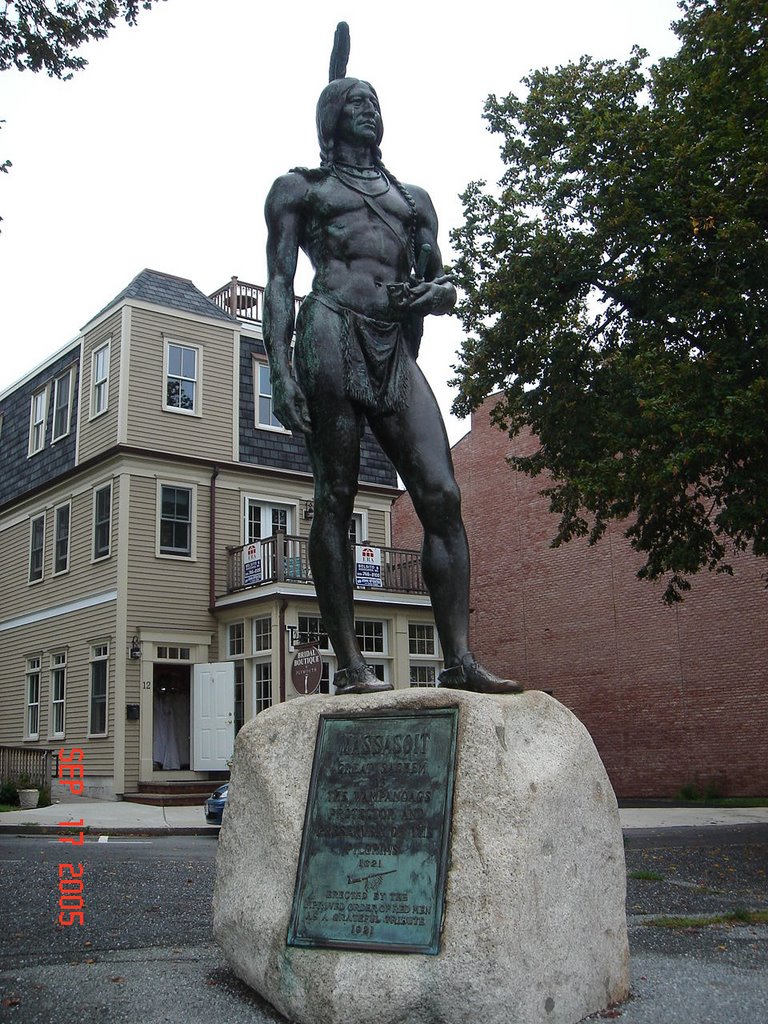
Statue of Massasoit, Plymouth, MA. Author’s photo
He acted as an interpreter for the Wampanoag tribe (“People of the First Light”) and its chief, Massasoit, which translates to “he who is great.”
The fact that Squanto already knew English before the Pilgrims landed is what is remarkable.
How did Squanto learn English, how did he know European customs and languages, how did he lose his tribe?
Squanto, Ambassador to Native American Tribes

Tisquantum (“Squanto”) teaching the Plymouth colonists to plant maize. Image: Wikipedia
The man Tisquantum, better known as Squanto, was probably present at the first Thanksgiving celebration held by the Pilgrims. He was certainly there by 1621, after the winter when the Pilgrims lost half their population to starvation and disease, when another Native American, Samoset, of the Wampanoag tribe, introduced Squanto to the Pilgrim settlers, and Squanto became a member of their colony.
Because Squanto spoke English well, the Pilgrim leader, Governor William Bradford, asked him to serve as his ambassador to the Native American tribes.
Slavery and Europe
It was over a decade before the Pilgrims landed that Squanto was captured from Massachusetts and taken, along with about 20 other Native Americans, by Thomas Hunt, an English ship captain, who intended to sell them into slavery in Málaga, Spain.
There, however, a Spanish monk who was “vehemently opposed to brutality towards Native Americans” took Squanto from Hunt, freed him from slavery, treated him well, and taught him the Christian faith. Squanto eventually made his way to England, where he either learned or improved his English and worked in the stables of a man named John Slaney, merchant and treasurer of the Newfoundland Company. It was Slaney, sympathizing with Squanto’s desire to return home, who promised to put the Native American on the first vessel bound for America.
Release from Slavery and Return
Squanto worked on a ship for Captain John Mason, the Governor of the Newfoundland Colony. Squanto then found passage on a fishing ship that brought him south, where he eventually returned to Pawtuxet.
However, it was ten years after Squanto was first kidnapped, not until 1618, after a decade of exile, that Squanto returned home. There, he learned that his tribe had died from an epidemic, either local viral hepatitis from contaminated food or smallpox brought by the earlier English colonists. It was while he was living among the Wampanoag near present-day Plymouth, MA, that his friend Samoset introduced him to the new Pilgrim settlers. The Pilgrims called Squanto:
“a spetiall instrument sent of God for [our] good.”
In November of 1622, he led the Pilgrims on a trading mission around southern Cape Cod to what is now Chatham, when his nose began to bleed, indicating that he had come down with an indigenous illness.
As Squanto lay mortally ill with fever, he asked the Pilgrim leader, William Bradford, to kneel at his bedside. According to Bradford’s diary, Squanto asked him to “pray for him, that he might goe to the Englishmen’s God in heaven.” Squanto died within a few days, having bequeathed his possessions to the Pilgrims “as remembrances of his love.”
Bill Petro, your friendly neighborhood historian
billpetro.com

“The fact that he already knew English before the Pilgrims landed is what is remarkable.” ……A-a-a-a-n-d you don’t even address this?
John,
Did you read the 5th paragraph where I wrote “Squanto eventually made his way to England — where he either learned or improved his English”?
-Bill