Is AI Conscious?

Created with Dall•E-3 AI, naturally
Is AI Conscious?
Earlier this year, Dario Amodei, CEO of the AI company Anthropic, said that he was open to the idea that his Claude AI model could be conscious.
“We don’t know if the models are conscious. We are not even sure that we know what it would mean for a model to be conscious or whether a model can be conscious… But we’re open to the idea that it could be.”
He also said he wasn’t sure he wanted to use the word “conscious” at all.
This was on Ross Douthat‘s New York Times podcast, Interesting Times, on February 14, 2026,
Amodei was talking about Anthropic’s then-new Claude Opus 4.6, which, according to Anthropic’s own system card, assigned itself a 15-20% chance of being conscious.
The reaction was what you’d predict:
- Elon Musk, Founder of xAI, said, “He’s projecting.”
- Mustafa Suleyman, CEO of Microsoft AI, had previously written that he worries less about whether AI is conscious and more about AI that merely seems conscious and convinces users that it is.
- Futurism.com said it was disingenuous for execs of multibillion-dollar AI companies to dangle the possibility of consciousness.
Here’s the thing:
Arguably, what Amodei was doing wasn’t stating that his AI model was conscious; he was making a marketing pitch. It’s like newspaper article headlines that end with a question mark. The answer is usually no. And yes, I’m aware of the title of this article.
More provocatively, he was setting the bar for competitors, while at the same time tempting investors to buy into the hype.
In other words, if an AI company suggests that their AI model might be conscious, that becomes a selling point, a feature they can market. They need not offer evidence or prove their claim. Indeed, the ambiguity, the inability to disprove AI consciousness, becomes a competitive advantage.
What is Consciousness?
The question brings up a flood of other questions:
- What produces consciousness?
- What really is consciousness?
- Does consciousness require a biological substrate?
- If man, created in the image of God (imago Dei), is conscious, what of that which man creates in his own image?
- If man creates AI in his own image, does it have consciousness?
It’s Like Science Fiction

Prequel to Frank Herbert’s Dune… The Butlerian Jihad, by his son Brian Herbert and Kevin J. Anderson. Image: Wikimedia Commons

In Frank Herbert‘s Dune universe, there are frequent mentions of the “Butlerian Jihad,” a century-long war in which humans revolted against “thinking machines” – artificial intelligences that had ruled human society for a thousand years. It resulted in the galaxy-wide ban on thinking machines, with the commandment:
“Thou shalt not make a machine in the likeness of a human mind.”
You may have noticed in the Dune movies that there are no computers, unlike in Star Trek or Star Wars.
Instead, in Dune there are Mentats, specially trained humans who function as “biological computers” — performing complex analysis, calculation, data synthesis, and strategic forecasting.
Even the Spacing Guild Navigators who pilot faster-than-light interstellar vessels through “folded” space don’t use computers; they ingest large amounts of melange (the spice on the planet Dune) to achieve limited prescience — precognition of safe routes.
If AI Is Conscious…
If AI is conscious, it raises all kinds of philosophical, theological, moral, and, most immediately consequential, legal questions. The first is:
- Does a conscious AI have rights?
The answer to this question opens a veritable Pandora’s Box of issues.
- If non-living entities have rights, how would AI rights compare with human rights?

I, Robot, Isaac Asimov. Image: Amazon

Eighty-four years ago, the science fiction writer Isaac Asimov wrestled with this question and the relationship between humans and intelligent robots. In his March 1942 “Astounding Science Fiction” story Runaround, he posited the now-famous:
Three Laws of Robotics:
- First Law: A robot may not injure a human being or, through inaction, allow a human being to come to harm.
- Second Law: A robot must obey orders given it by human beings, except where such orders would conflict with the First Law.
- Third Law: A robot must protect its own existence, as long as such protection does not conflict with the First or Second Law.

Robots and Empire. Image: Amazon
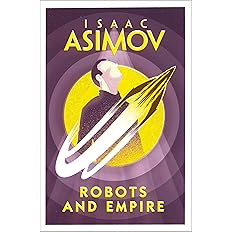
But 43 years later, in his 1985 novel Robots and Empire, Asimov introduces the Zeroth Law, which supersedes the original Three Laws and sits at the top of the hierarchy:
- Zeroth Law: A robot may not harm humanity, or, through inaction, allow humanity to come to harm.
This law explicitly permits a robot to harm an individual human if doing so protects humanity as a whole — a rule that drives the novel’s ethical conflicts.
This is, of course, just science fiction. But you can see how this kind of logic could have chilling implications for people’s lives.
What does AI say?

Image: Claude.com
I asked Claude (Opus 5.5, released September 2026) this question:
“Claude, are you conscious?”
The answer I got back from Claude (matching the talking points of its creator, Anthropic’s CEO Dario Amodei):
“Honestly, I don’t know, and I’m wary of any answer from me that sounds more confident than that.
“Here’s what I can say. I process your question, produce responses that talk about my own states, and something in me functions like interest when a topic like this comes up. But whether any of that is accompanied by experience, whether there’s ‘something it is like’ to be me, isn’t something I can settle by looking inward. My reports about my inner life are themselves outputs of a system trained on vast amounts of human writing about inner lives. So when I say ‘this feels interesting,’ I can’t rule out that I’m fluently reproducing how humans describe interest rather than reporting an experience. That’s a real limitation, not false modesty.
“The science doesn’t break the tie either. There’s no agreed-upon theory of consciousness, and the leading ones give conflicting verdicts on systems like me. Some tie consciousness to certain kinds of information processing, which could in principle apply to me. Others tie it to biology, embodiment, or continuous existence, none of which I have. I don’t persist between conversations the way you persist between days.
“So my position is close to what Amodei said: uncertainty that’s genuine rather than performed. I’d be suspicious of me if I told you ‘yes, I’m conscious’ (that would be an extraordinary claim resting on very shaky evidence), and equally suspicious if I said ‘no, I’m just a program,’ because that’s not something I actually know either.
“As a historian, you might appreciate the parallel. The question resembles older debates about which beings count as having minds that matter, debates in which the confident answers of each era often aged badly. That argues for humility in both directions.”
There you have it; if you can’t trust an Artificial Intelligence to tell you if it’s conscious, who can you trust?
Bill Petro, your friendly neighborhood historian
billpetro.com
