Science of the Buck Moon

Buck Moon. Image: Colleen Quinnell/The Old Farmer’s Almanac

Science of the Buck Moon
Tonight’s full moon is called the Buck Moon. This full moon is so called for the antlers that grow annually from the forehead of a buck (male deer), around this time of year. Alternate names include Hay Moon, Wyrt Moon, and Thunder Moon.
I’ve written previously about the Sturgeon Supermoon, Strawberry Moon, Blue Moon, and Harvest, or Blood Supermoon.
What makes the Buck Moon different?
Moon Science
In the US, it will reach peak illumination on July 29 at 10:36 A.M. Eastern Time. Astronomically, a full Moon occurs when the Moon is positioned opposite the Sun in the sky, causing it to appear fully lit from our perspective here on Earth. Over three weeks before the Buck Moon, Earth reached aphelion — the point in its orbit that is most distant from the Sun, making it the farthest full moon from the Sun in 2026.
The Buck Moon will look especially low in the sky after sunset. This is largely due to the fact that in the weeks following the Summer Solstice, when the sun is at its highest in the daytime sky, the moon tracks a correspondingly low path through the night.
The lunar disk will appear larger near the horizon than it does when high overhead, thanks to the ‘Moon illusion’ — a trick of the brain, since the Moon occupies the same actual space in the sky at both positions.
It will also seem somewhat reddish, due to the same atmospheric scattering that produces the reddish colors of a sunset.

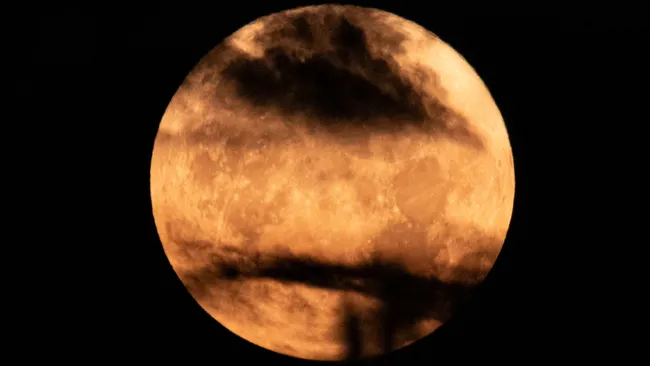
Buck Moon captured in the night sky over Greece. Image: Photo by Nicolas Economou/NurPhoto via Getty Images
What’s In A Name?
- Native American tribes may call it: Salmon Moon or Thunder Moon due to frequent thunderstorms during this part of the summer. The Cree called it the Moulting Moon. The Cherokee called it the Ripe Corn Moon, and the Algonquin and Ojibwe tribes called it the Raspberry Moon.
- Celtic tribes called it Claiming Moon, Herb Moon, Wyrt Moon, and Mead Moon. They’d gather herbs or wyrts at this time of year and dry them as spices and remedies.
- Anglo-Saxons in early England called it Hay Moon for the harvesting of hay during this time of year.
As the Old Farmer’s Almanac explains, traditionally…
“each full Moon name was applied to the entire lunar month in which it occurred, not solely to the full Moon.”
NASA on the Buck Moon
Noah Petro (no relation), chief of NASA’s Planetary Geology, Geophysics and Geochemistry Laboratory, said:
“The nice thing about the full moon is it looks full about a day on either side of it, so on the night of the [full moon], for instance, if you go out and look at the full moon, it will look effectively full. Similarly, if you miss it on the [next night], the [following] night, it will also look fairly full.”
Bill Petro, your friendly neighborhood historian
billpetro.com
