History Articles
 HISTORY OF THE STAR
The Star of Bethlehem has puzzled scholars for centuries. Some have skeptically dismissed the phenomenon as a myth, a mere literary device to call attention to the importance of the Nativity. Others have argued that the star was miraculously placed there to guide the Magi and is therefore beyond all natural explanation. Most authorities, however, take a middle course which looks for some historical explanation for the Christmas star, and several interesting theories have been offered.
The Greek term for star in the Gospel account, “aster“, can mean any luminous heavenly body, including a comet, meteor, nova, or planet (wandering star). The Chinese have more exact and more complete astronomical records than the Near East, particularly in their tabulations of comets and novae. In 1871, John Williams published his authoritative list of comets derived from Chinese annuals. Comet No. 52 on the Williams list appeared for some seventy days in March-April of 5 B.C. near the constellation Capricorn, and would have been visible in both the Far and Near East. As each night wore on, of course, the comet would seem to have moved westward across the southern sky. The time is also very appropriate. This could indeed have been the wise men’s astral marker. Comet No. 53 on the Williams list is a tailless comet, which could well have been a nova, as Williams admitted. No. 53 appeared in March-April of 4 B.C.-a year after its predecessor – in the area of the constellation Aquila, which was also visible all over the East. Was this, perhaps the star that reappeared to the Magi once Herod had directed them to Bethlehem in Matthew 2:9? Comets do not display all the characteristics described in the full Nativity story. A planet or planets seems more likely.
The astronomer Johannes Kepler noted in the early 17th century that every 805 years, the planets Jupiter and Saturn come into extraordinary repeated conjunction, with Mars joining the configuration a year later. Since Kepler, astronomers have computed that for ten months in 7 B.C., Jupiter and Saturn traveled very close to each other in the night sky, and in May, September, and December of that year, they were conjoined. Mars joined the configuration in February of 6 B.C. The astrological interpretation of such a conjunction would have told the Magi much, if, as seems probable, they shared the astrological lore of the area. Jupiter and Saturn met each other in Pisces, the Fishes.
In ancient astrology, the giant planet Jupiter was styled the “King’s Planet”, for it represented the highest god and ruler of the universe: Marduk to the Babylonians; Zeus to the Greeks; Jupiter to the Romans. The ringed planet Saturn was deemed the shield or defender of Palestine, while the constellation of Pisces, which was also associated with Syria and Palestine, represented epochal events and crises. So Jupiter encountering Saturn in the sign of the Fishes would have meant that a divine and cosmic ruler was to appear in Palestine at a culmination of history.
Meanwhile, new research on the star based on recently available astronomy software and historical research on Josephus’ manuscripts is being conducted and collected at www.bethlehemstar.net.
Bill Petro, your friendly neighborhood historian
www.billpetro.com
Inspired by Paul L. Maier’s In the Fullness of Time
 HALLOWEEN
Halloween (Allhallows Even) is the evening of October 31. In its strictly religious aspect this occasion is known as the vigil of Hallowmas or All Saints’ Day, November 1, observed by the Roman Catholic and Anglican churches. In the fourth decade of the 8th century, Pope Gregory III moved this holiday to this date (from May 13) for celebrating the feast when he consecrated a chapel in St. Peter’s basilica in Rome to all the saints. Gregory IV extended the feast to the entire church in 834. In Latin countries the evening of October 31 is observed only as a religious occasion, but in Great Britain, Ireland, and the United States, ancient Halloween folk customs persist alongside the ecclesiastical observance.
Halloween is the second most popular holiday in the U.S. after Christmas, at least according to retailers. Not only are candy and costumes popular purchases, but houses are being decorated with "Halloween lights." Parties are popular and are increasingly being celebrated the weekend before. In Boston, for example, Salem is a popular location for these with its month-long Haunted Happenings celebrations — due to the Salem Witch Trials of 1692 — and the Massachusetts Turnpike traffic signs point out that Salem can be reached from Boston via Route 1A North. Young people in Tokyo dress up in costumes during Halloween.
Students of folklore believe that the popular customs of Halloween show traces of the Roman harvest festival of Pomona and of Celtic Druidism. These influences are inferred from the use of nuts and apples as traditional Halloween foods and from the figures of witches, black cats, and skeletons commonly associated with the occasion.
In pre-Christian Ireland and Scotland, the Celtic year ended on October 31, the eve of Samhain, and was celebrated with both religious and harvest rites. For the Druids, Samhain (pronounced: SOWin) was both the “end of summer” and a festival of the dead. The spirits of the departed were believed to visit their kinsmen in search of warmth and good cheer as winter approached. It was also an occasion when fairies, witches, and goblins terrified the populace. The agents of the supernatural were alleged to steal infants, destroy crops, and kill farm animals. Bonfires were lighted on hilltops on the eve of Samhain. The fires may have been lighted to guide the spirits of the dead to the homes of their kinsmen or to kill and ward off witches. In the City Center of modern day Dublin one can find signs advertising “Samhain Halloween” parties. Samhain is also the name for November in the modern Scots Gaelic and Irish languages.
During the middle ages when the common folk believed that witchcraft was devoted to the worship of Satan, this cult included periodic meetings, known as witches’ Sabbaths, which were allegedly given over to feasting and revelry. One of the most important Sabbaths as held on Halloween. Witches were alleged to fly to these meetings on broomsticks, accompanied by black cats who were their constant companions. Stories of these Sabbaths are the source of much folklore about Halloween.
In 17th century Puritan New England the celebration of Halloween was banned, along with any special celebration of Christmas and Easter, though in Catholic Maryland and Anglican Virginia retained some Halloween customs. During 19th century Victorian times, Halloween was generally tame and devoid of occult overtones. Instead of pulling pranks or haunting neighborhoods, young people chatted and flirted in festooned parlors.
By the early part of the 20th century, Halloween became almost a civic affair with block parties and parades. Pranks and mischief were common on Halloween. Wandering groups of celebrants blocked doors of houses with carts, carried away gates and plows, tapped on windows, threw vegetables at doors, and covered chimneys with turf so that smoke could not escape. In some places boys and girls dressed in clothing of the opposite sex and, wearing masks, visited neighbors to play tricks. These activities generally resembled the harmful and mischievous behavior attributed to witches, fairies, and goblins.
The contemporary “trick or treat” custom resembles an ancient Irish practice associated with Allhallows Eve. Groups of peasants went from house to house demanding food and other gifts in preparation for the evening’s festivities. Prosperity was assured for liberal donors and threats were made against stingy ones. These contributions were often demanded in the name of Muck Olla, an early Druid deity, or of St. Columb Cille, “dove of the Church” (also known as St. Colomba) who was an Irish missionary to Scotland during the 6th century. In England some of the folk attributes of Halloween were assimilated by Guy Fawkes day celebrated on November 5. Consequently Halloween lost some of its importance there.
Immigrants from Great Britain and Ireland brought secular Halloween customs to the U.S., but the festival did not become popular in this country until the latter part of the 19th century. This may have been because it had long been popular with the Irish, who migrated here in large numbers after 1840. In America, though some churches observe Halloween with religious services, many people regard it as a secular festival. Other Protestant churches celebrate it as “Reformation Day” in commemoration of the date in 1517 when Martin Luther nailed the 95 Theses to the northern wooden door of the Castle Church in Wittenberg.
Bill Petro, your friendly neighborhood historian
www.billpetro.com
HISTORY OF PATRIOT DAY
With the following words and many others, President George W. Bush designated September 11 to be regarded as Patriot Day, or America Remembers:
By the President of the United States of America
A ProclamationOn this first observance of Patriot Day, we remember and honor those who perished in the terrorist attacks of September 11, 2001. We will not forget the events of that terrible morning nor will we forget how Americans responded in New York City, at the Pentagon, and in the skies over Pennsylvania — with heroism and selflessness; with compassion and courage; and with prayer and hope. We will always remember our collective obligation to ensure that justice is done, that freedom prevails, and that the principles upon which our Nation was founded endure.
The President inaugurated this observance on September 4, 2002 and repeated it the next year, following a joint resolution approved December 18, 2001 along with the US Congress, intending that it be firmly planted into the consciousness of the American people, and each year recalled to our memory “that more than 3,000 innocent people lost their lives when a calm September morning was shattered by terrorists driven by hatred and destruction.”
As the sixth anniversary of what most people call September 11th or just 9-11, I am reminded of the article I wrote in the wake of it, and the one I wrote a year following. Should we remember these kind of events, recalling history? The words of the Oxford don C.S. Lewis are particularly relevant.
Most of all, perhaps, we need intimate knowledge of the past. Not that the past has any magic about it, but because we cannot study the future, and yet need something to set against the present, to remind us that the basic assumptions have been quite different in different periods and that much which seems certain to the uneducated is merely temporary fashion. A man who has lived in many places is not likely to be deceived by the local errors of his native village; the scholar has lived in many times is therefore in some degree immune from the great cataract of nonsense that pours from the press and the microphone of his own age.
– from “Learning in War-Time” (The Weight of Glory)
Lest we forget
Bill Petro, your friendly neighborhood historian
www.billpetro.com

1964 Red Rocks Beatles
“1964” BEATLES TRIBUTE AT RED ROCKS IN DENVER
It was 43 years ago today
Sgt Pepper taught the band to play
They’ve been going in and out of style
But they’re guaranteed to raise a smile
Indeed, 43 years ago today, on August 26, 1964, the Beatles performed a concert at Red Rocks, a beautiful natural amphitheater above Denver. Last night, a Beatles tribute band named “1964” performed at Red Rocks. This tribute band looks like, sounds like, moves like, and sings like the Beatles. They used authentic costumes and instruments.

I’ve seen a number of Beatles tribute bands over the decades, but this was by far the best. In fact, back in 1964, my brother, sister, and cousin did a Beatles “karaoke” at the school talent show. Of course, we won! I played Paul, left-handed, to be sure.
This band is unique, though, in that they confine their repertoire to the music of the early Beatles rather than the entire canon. While this limits them to pre-Sgt. Pepper music, it allows them to play some often neglected tunes that other cover bands don’t do. The evening took me back to that night on February 9, 1964, as we sat in front of the TV and watched Ed Sullivan introduce us to The Beatles.
The Look
The band even mimicked the stance. John had the wide horse stance with the tapping left foot, Paul had the trademark head bobble, George the stiff stance with one knee out, and Ringo had the head nod and occasional tilt. They even did the signature deep bow after each song. By the way, for a mop top tribute of a different kind, catch the movie “That Thing You Do” where Tom Hanks, the band’s manager, instructs the boys to bow.
The Sound
Their songs were practically pitch-perfect, a close approximation to the Beatles studio work. Ironically, they played better than the Beatles played during their live performances when they could barely hear themselves sing above the screaming fans. Indeed, a few years ago, when I caught Paul McCartney at the Denver Pepsi Center in his first concert back in Denver since then, he mentioned that his last time in the area was when they performed at Red Rocks. “But we could barely finish a half hour set… because we couldn’t breathe!” Indeed, Denver is a mile high, but Red Rocks is even higher, at an elevation of 6,200 feet.

This band, “1964,” did a two-hour set, including the break. Compare this to the original show, with a warm-up by the Righteous Brothers and Jackie de Shannon, with the Beatles playing for about 25 minutes. This band has been doing this for 23 years, 7 times at Carnegie Hall and at other original Beatles venues, plus Paul McCartney and Ringo Starr have their CD. They originally played Red Rocks 3 years ago, in 2004, on the 4oth anniversary of the Beatles’ original concert here. “John” is performed by Mark Benson, “Paul” by Gary Grimes (he even has the arched eyebrows correct), “George” by Tom Work, and “Ringo” by Terry Manfred.
The Voices
Their singing was outstanding, and their speaking accents were good, but I did catch a few non-Liverpudlian pronounced words from Paul. John did the kind of light-hearted banter you’d expect, and it was spot on.
The Songs
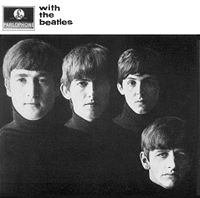 They started their set with one of their biggest early hits
- I Want To Hold Your Hand
which was a hit not only in the UK and US but in Germany as well, as the band recorded it in German too.
- Please Please Me
followed that, another #1 for the band in 1963, with curiously and to fans’ consternation, was not on the recent compendium of Beatles #1 hits called, ironically, “The Beatles 1.”
- From Me to You
was their next tune, followed by
- Thank You Girl
a song rarely covered by a tribute band.
Next, we heard George on
- Do You Want to Know a Secret
which was a #2 Billboard hit for him
- All My Loving
by Paul was spot on.
- This Boy
sung by John was quite moving. It was featured in their first movie, “A Hard Day’s Night,” as an instrumental by the name “Ringo’s Theme,” but here, John even had the facial expressions down right. He had the sideburns, the hair combed to the side, and even had his eyebrows go up in the center.
Next, Paul told us that Ringo had mentioned to him that he wanted to sing the next song in the worst way, and that was exactly how he was going to do it. Ringo wondered aloud, “Was that a left-handed compliment?” He then sang what was previously a #1 country hit for Buck Owens
- Act Naturally
This was followed by a song the Beatles never performed live
- Eight Days a Week
Then came
- A Hard Day’s Night
whose title came from a remark made by Ringo Starr. And in this rendition on stage, we got lots of cowbell.
- It’s Only Love
with John’s effortless phrasing and George’s brassy lead guitar.
- And I Love Her
with Paul singing to a cha-cha beat. He was dead on and even did Paul’s upturned chin.
- Nowhere Man
was next, sung by John, who wrote almost all of it, somewhat autobiographically.
- Can’t Buy Me Love
followed, another moving #1 tune, written while the Beatles were staying in the George V hotel in Paris.
Next, John asked the audience for the next song to stand up and sing along — as if he could stop them.
- Twist and Shout
Though not written by the Beatles became a huge hit for them and for Ferris Bueller on his day off.
The band took a break, during which strangely off-putting “ballpark organ” versions of Beatles music was played.
Mercifully, this was a short break, and they resumed with Paul saying, “one-two-three-FAH”
- I Saw Her Standing There
Then George did the classic Chuck Berry tune
- Roll Over Beethoven
- Ticket to Ride
came next from the movie Help! though Paul had a hard time hitting “my baby don’t care” at the end.
One of the most beautiful and archly autobiographical songs from Rubber Soul by John followed
- In My Life
The original had a baroque-styled piano instrumental bridge by their producer George Martin.
- And Your Bird Can Sing
from Revolver took me back to watching the Beatles cartoon show on Saturday mornings. During this song, we noticed that John seemed to have a budding double chin like Paul’s, but who doesn’t? This was followed by George singing
- Taxman
from Revolver, actually written by George after he discovered how much he was paying in taxes.
- Paperback Writer
which I recall was knocked off the #1 spot by Frank Sinatra’s “Strangers in the Night.” It pleased my mother at the time but not me. This song, at least, has a lovely 4-part harmony.
- Rain
the B-side to the Paperback Writer single followed. Ironically, I saw one of the early tribute bands who took this title as their name perform in Disneyland in 1980. The Beatles never performed this in concert. This was the Beatles first tune with backward vocals.
- Yellow Submarine
was a huge hit in 1966 and served as the theme for the 1968 animated movie. I recall asking my father to attend with us. He didn’t like it. The song went to #1 with Ringo on lead. During this concert, we were encouraged to supply the sound of the submarine during the bridge. “Surface, surface.”
- Help!
another #1 hit followed. The film, by the same name, starts this song with a James Bond intro.
- I Feel Fine
was one of the first hits to begin with guitar feedback and a wicked riff. And some conflicting reports by the Beatles themselves suggest that this is the first overt reference to LSD in one of their songs.
- She Loves You
a huge crowd pleaser had everyone on their feet. Though it was written in 1963, it set a record as one of the five Beatles hits that held the top five positions on the American charts. Like “I Want To Hold Your Hand” (Komm Gib Mir Deine Hand), it too was recorded in German as Sie Liebt Dich.
The band left the stage, with few leaving. As anticipated, they took the stage after dimmed lights with their encore.
Ringo then did
- I Wanna Be Your Man
though not one of the more memorable songs, nor deep in terms of lyrics, it has lots of energy and allowed the band a bit of jamming.
This was followed by a reminder that we had Some Fun Tonight with
- Long Tall Sally
an ironic song, to be sure. The song was originally done by Little Richard, whom the Beatles used to open for in their early days in both Liverpool and Hamburg. Paul sings this a whole step higher than the original.
Conclusion
As I left the amphitheater, I realized what a good time I had had. This band brought back rich memories. When I applied to history graduate school, I was told, “there’s no future in history,” but there certainly is a future for nostalgia.
This band sings the soundtrack of my youth.
Bill Petro, your friendly neighborhood historian
billpetro.com
 HISTORY OF AUGUST
What’s in a name? The name of this month wasn’t always August, previously it was called Sextilis by the Romans. The Roman Senate, in 8 B.C. decided to honor their first Emperor, Augustus Caesar, by changing the name of the month to Augustus. Now Augustus wasn’t his name, it was more of a description of his importance. He was born as Gaius Octavius, though he is known in the history books as Gaius Julius Caesar Octavianus, or Octavius to his friends. The word augustus in Latin means “venerable” or “consecrated,” coming from the root augur which means to “consecrate by augury.” We use the term in English to describe someone auspicious, grand or lordly… or with imperial qualities.
You know about Augustus from the Christmas story in Luke 2:
Now in those days a decree went out from Caesar Augustus, that a census be taken of all the inhabited earth [i.e., the Roman Empire].
 Back in Rome, his mother was the niece of Julius Caesar and his father was governor of Macedonia, though he was only of the equestrian order, not the highest senatorial rank. Nevertheless, the young Octavius rose in status. He was elected to the College of Pontiffs and later joined his great-uncle Julius Caesar on the battle field. The general and dictator was so impressed, he changed his will and named the boy his prime beneficiary. As Caesar had no legitimate heir, this adoption meant Octavius would succeed him. Octavius took the name Gaius Julius Caesar, though Roman tradition required that he append the surname Octavianus (or Octavian) to denote his biological family. So he is alternatively known as Octavius, Octavian, or Augustus.
Bill Petro, your friendly neighborhood Roman
www.billpetro.com
 HISTORY OF REEK SUNDAY, Part 3: LOCATION

In County Mayo in Ireland, Cruach Phadraig — as it is known in Irish — is also called “The Reek.” It stands at 764 meters or 2510 feet elevation. It is located about 5 miles from the lovely town of Westport , an Irish Tidy Town . St. Patrick’s “Confessions” tells of his slavery in the wood of Fochluth . Evidence relating to the history of St. Patrick suggests that this location was actually on the west shore of Ireland in this area.
 Westport is a popular tourist destination in County Mayo, not only as a launching point for the pilgrimage, but for its picture postcard beauty. In the center of the town is an octagon with a pillar featuring St. Patrick. On each of the eight sides is a panel illustrating an event from his life.
 The Book of Armagh , a vellum book on display alongside the fabled and ornately illustrated “Book of Kells” at the Trinity College Library in Dublin, is thought to have been written by the hand of Patrick himself and tells of him hearing of the Wood of Fochloth and agreeing to undertake a mission there because of the children crying with a loud voice saying “Come O Holy Patrick to save us.” Though Patrick began his evangelization of Ireland in 432 AD, it wasn’t until 9 years alter that he reached Croagh Patrick just before Easter of 441 AD, or more specifically before Lent.
Bill Petro, your friendly neighborhood historian
www.billpetro.com

070707
July 7, 2007.
Even more — seven AM, seven minutes and seven seconds: 07:07:07 07/07/07. That won’t happen again, at least for 12 more hours. It would make James Bond envious.
Of course, we recently had an event like this at three minutes and four seconds after 2 AM on the sixth of May of this year, namely 02:03:04 05/06/07.
I mentioned something similar last year, on April 5 at two minutes and three seconds after 1 o’clock, the time and date was 01:02:03 04/05/06. What is unique about this current phenomena, however, is that it doesn’t change if you live in Europe or someplace that uses dd/mm/yy format.
These kind of things happen more frequently than you’d think. I remember when I was a kid, being impressed that pennies that were dated 1961 had a date that looked the same upside down.
Bill Petro, your friendly neighborhood historian
billpetro.com
Reading Time: 4 minutes
 HISTORY OF INDEPENDENCE DAY
Independence Day, or the Fourth of July celebrates the adoption by the Continental Congress on July 4, 1776, of the Declaration of Independence, proclaiming the severance of the allegiance of the American colonies to Great Britain. It is the most significant secular holiday in the United States, observed in all the states, territories, and dependencies.
Although it is assumed that the Continental Congress unanimously signed the document on the 4th of July, in fact, not all delegates were present, and there were no signers at all, contrary to the theatrical musical 1776. Here is what really happened. (more…)
Reading Time: 2 minutes PENTECOST
The Feast of Pentecost is taken from the Greek word πεντηκόστη which means “the 50th,” referring to the fiftieth day after Passover and Easter. In the Jewish calendar, this would coincide with the harvest festival Shavuot the “Feast of Weeks.” In the Christian calendar, Passover played a part in a number of visits Jesus made to Jerusalem, but most famously, it marked the coming of the Holy Spirit, as “tongues like as of fire” upon the Disciples of Jesus along with the sound of rushing wind, as told in the New Testament Book of Acts Chapter 2.
This marked the beginning of the work of the Church following the Resurrection of Jesus. Indeed, as the New Testament tells us that Jesus remained with his Disciples for 40 days following his Resurrection before his Ascension (celebrated last Sunday), this would mark 10 days following the Ascension of Jesus. This event was associated with the Disciples speaking in other languages. Many visitors to Jerusalem, who were likely there for the Feast of Passover, were curious about the meaning of the flames, wind, and foreign tongues — some familiar to them. The Apostle Peter gave his first sermon and the Church in Jerusalem grew in size from 120 believers to 3,000.
While Ascension Sunday is not much celebrated in the US — rather in parts of Europe, especially Germany — Pentecost Sunday is also not much celebrated in the US, other than in more liturgical churches. It is celebrated in various regions of Europe. In parts of Eastern Europe it is known as Green Sunday or Green Holiday where it is attended by wearing green and decorations with green branches — perhaps a reference back to the Jewish festival of Shavout and its decoration of the synagogue with green. Pentecost is recognized as a bank holiday in the United Kingdom, where it’s known as Whitsun or Whitsun Day, meaning either White Sunday, or the Sunday when whit or wisdom was brought upon the Disciples.
Bill Petro, your friendly neighborhood historian
www.billpetro.com
Reading Time: 3 minutes
 HISTORY OF SPIDER-MAN


There is something about being first in line for the midnight showing of the premiere of a summer blockbuster, not to mention that I was probably the oldest person in the theater.
The Experience: A young friend of mine insured our place at the front of the line by camping out since Monday for the Friday 12:01 AM premier. You’ve heard of people who bring a tent and a sleeping bag — this young man built a Spider-Man Den, a veritable “Spidey Suite” in the portico in front of the theater, including posters, a couch, chairs, coffee table, rug, TV, game consoles, a projection screen, and a DVD player where they watched Spider-Man 1 and 2.

 It helped that he’s been doing movie campouts for 5 years and knows the General Manager and mall owner. He even had sponsors: Lowe’s supplied the lumber, Chipotle’s brought burritos daily, Sideshow Collectibles provided giveaway cards for everyone in the theater(s). This movie complex has gone digital, meaning they don’t need multiple expensive film prints, but the movie is played off a hard disk. Seven theaters showed the movie after midnight. Before the movie we were treated to previews of other upcoming summer blockbusters: Shrek-III, Pirates-3, Harry Potter-5, and Fantastic Four-2.
We had gotten into the theater for first showing 2.5 hours before the film rolled. Trivia contests, feats of Spider Strength, and Sony Pictures giveaways ensued. Oh, how it took me back to my youth when I collected comic books for 22 years. I sold my entire collection to buy my then-fiancée an engagement ring. I went cold turkey, but I can still remember.
 History: I started reading and collecting comic books in 1961, both DC and Marvel comics. Spider-Man first appeared in August 1962 in Amazing Fantasy #15. The storyline for the first two movies was taken from the comic book characters and timeline during the 1960s and ’70s, but Spider-Man 3 uses a villain, Venom, who first appeared in 1988.
Spider-Man has become the flagship comic for Marvel, in the same way as Superman for the DC line. But Marvel had its finger on the pulse of 60’s teens – the major comic buying demographic – in a way that took DC longer to catch on to. Spider-Man was the story of shy though bright high school teen Peter Parker who was bitten by a radioactive spider and gained surprising spider-like powers. But unlike the more straight-arrow Superman or other DC comic heroes of the 60’s, Marvel in general and Spider-Man in particular dealt with teen angst, psychological conflict, and moral ambiguities. This character, initially developed by artist Steve Ditko and writer Stan Lee (who has had cameos in all the Spider-Man movies) connected with youth during a turbulent era and a difficult age. Peter had classmate and girlfriend problems, employment challenges, and unresolved guilt over his uncle’s death. Yet his free-style fighting style and wise-cracks during combat with villains helped him cope. Spider-Man became more than a cult hero – at one time he had four regular monthly comic books in publication.
 Movie review: Without telling you the plot of the movie, I will say that I found this third movie quite enjoyable and satisfying, from the fabulous special effects — at $250-300M this is one of the more expensive, if not the most expensive movie in history — to some standout performances. I am a bit kinder with my review than the critics. I’d give this movie a “B” primarily for the performances rather than either the writing, dialog or pacing. Some of the standouts include Tony and Emmy award-winning actress Rosemary Harris as Peter’s Aunt May, who I met in London a few years ago. She has a remarkable presence in person as well as on the screen.
Thomas Haden Church (Oscar nomination in Sideways) played Sandman, who while not as threatening as Doctor Octopus, portrayed a tortured misunderstood criminal. Even James Franco — who looks like James Dean and played him in a TV movie — as the tormented Harry Osborn, turned in a less one-dimensional performance than he did in Spider-Man 2. Tobey Maguire got to stretch in several directions, both physically and emotionally, as he portrayed a more aggressive side of his personality. J.K. Simmons as J. Jonah Jameson chews up every screen he’s in. Topher Grace, who you know as the lead in “That ’70s Show” was a bit too unctuous for my taste, and Kirsten Dunst, who I have loved in other roles seems miscast as Mary Jane Watson. In the comic book, MJ is a saucy, sexy persona and not a whiner — though her hair color looks better in this movie than in the previous ones.
 Speaking of hair, a natural redhead appeared as the blond Gwen Stacey, played by Bryce Dallas Howard, daughter of Ron Howard, and last seen in the movie Lady in the Water. She makes a striking appearance in this movie, though in the comics, she was Peter Parker’s second girlfriend and MJ Watson was his third.
Did you know: For the last 22 years I’ve been signing my articles “Bill Petro, your friendly neighborhood historian.” I got it from the very earliest days of the comic book when Peter Parker called himself “your friendly neighborhood Spider-Man.”
Bill Petro, your friendly neighborhood Spider-Fan
www.billpetro.com
Reading Time: 2 minutes HEROD ANTIPAS
Herod Antipas was the son of Herod the Great (whom we met in the Christmas story) and Malthake. After his father’s death in 4 B.C. he was made tetrarch of Galilee and Peraea in Trans-Jordan. Like his father, he was a lover of great and artistic architectural works, and built the beautiful Tiberias (named after guess who), as capital of his kingdom on the shore of the Sea of Galilee (which was renamed Sea of Tiberias).
 He was married to the daughter of Aretas, king of Arabia, but afterwards divorced her to the wrath of her father. Antipas found himself at war with the king and was saved only with the help of Rome. He took away from his half-brother, Herod Philip, his wife Herodias. Her influence over him led to his utter ruin. As you may recall the story of John the Baptist, the prophet denounced Antipas’ breaking the Jewish law by taking his brother’s wife. The historian Josephus further tells us that Antipas feared the prophet’s popularity with the people, and subsequently imprisoned him. Herodias did not like the Baptizer and after her daughter Salome pleased the ruler by her dance, after which he promised the girl anything up to half his kingdom, the head of John was requested. This execution did not make Antipas any more popular with the people.
 This is the Herod that Jesus called “that fox”. Jesus was not referring to personal pulchritude. From a study of Greek, Latin, and Hebrew literature it can be seen that the fox is both crafty and inferior in its position. The fox is an insignificant or base person, in contrast to the lion. He lacks real power and dignity, using cunning deceit to achieve his aims.
Bill Petro, your friendly neighborhood historian
www.billpetro.com
Inspired in part from Paul L. Maier’s In the Fullness of Time
Reading Time: < 1 minute IDES OF MARCH
According to the ancient Roman calendar, the ides fell on the 13th of the month with the exception of the months March, May, July, and October, when it fell on the 15th.
 It was on March 15, 44 B.C. that the Roman dictator Julius Caesar was assassinated. Contrary to popular belief, including William Shakespeare, Caesar was not assassinated in the Capitol, meaning the Curia Hostilia or Senate House in the Roman Forum at the foot of the Capitoline Hill (pictured at top), but rather near the statue of Pompey at the Theatrum Pompeium (pictured at right in the Largo di Torre Argentina in modern day Rome), where the Senate used to meet at that time. This precinct is now a Cat Sanctuary (as you can see the cat in the center of my photo) where I counted over a dozen homeless cats. They are regularly fed by local women.
 Marc Antony would have delivered his Shakespearean “Friends, Romans, Countrymen” speech from the Rostra of the Forum, directly across from the Curia (pictured at left).
 Dead bodies could not be kept inside the City, and Caesar was cremated in the Forum (at the location pictured on the right).
Bill Petro, your friendly neighborhood historian
www.billpetro.com