History Articles
 HISTORY OF THE CHRISTMAS TREE
It is generally believed that the first Christmas tree was of German origin dating from Boniface, English missionary to Germany in the 8th century, who replaced the sacrifices to Odin’s sacred oak by a fir tree adorned in tribute to the Christ child. The legend is told that Boniface found a group of “pagans” preparing to sacrifice a boy near an oak tree. He cut down the oak tree with a single stroke of his ax and stopped the sacrifice. A small fir tree sprang up in place of the oak. He told the pagans that this was the “tree of life” and stood for Christ.
Accounts persist that Martin Luther introduced the tree lighted with candles. Returning home after a walk one winter night, the story goes, he tried unsuccessfully to describe to his family the beauty of the starry night. He went out and cut down a small fir tree and put lighted candles upon it.
In a manuscript dated 1605 a merchant in Strasbourg, Germany wrote that at Christmas, “they set up fir trees in the parlors in Strasbourg and hang thereon roses cut out of paper of many colors, apples, wafers, spangle-gold and sugar. The custom of decorating the trees may have developed from the medieval Paradise Play. This play was a favorite during the Advent season because it ended with the promise of a Savior. The action in the play centered around a fir tree hung with apples.
In the fifteenth century, trees were decorated with wafers. Later, stars and flowers made from white pastry, and men and animals made from brown pastry, were used.
 The earliest date in England for a Christmas Tree was at Queen’s Lodge, Windsor by Queen Charlotte, the German born wife of George III, for a party she held on Christmas Day, 1800, for the children of the leading families in Windsor. Her biographer Dr John Watkins describes the scene:
In the middle of the room stood an immense tub with a yew tree placed in it, from the branches of which hung bunches of sweetmeats, almonds, and raisins in papers, fruits and toys, most tastefully arranged, and the whole illuminated by small wax candles. After the company had walked around and admired the tree, each child obtained a portion of the sweets which it bore together with a toy and then all returned home, quite delighted.
 The Christmas Tree was most popularized in England, however, by the German Prince Albert, soon after his marriage to Queen Victoria. In 1841, he began the custom of decorating a large tree in Windsor Castle. In 1848, a print showing the Royal couple with their children was published in the “Illustrated London News.” Albert gave trees to Army barracks and imitation followed. From this time onwards, the popularity of decorated fir trees spread beyond Royal circles and throughout society. Even Charles Dickens referred to the Christmas tree as that ‘new German toy’. German immigrants brought the custom to the United States and tree decorating is recorded back to 1747 in Bethlehem, Pennsylvania.
Many individuals and communities vie for the honor of having decorated the first Christmas tree in America. One interesting story tells of Hessian soldiers who fought for George III in the Revolutionary War. As they were keeping Christmas in Trenton, New Jersey around a decorated tree, they left their posts unguarded. George Washington and his troops were hungry and freezing at Valley Forge, but they planned their attack with the knowledge that the Hessians would be celebrating and thus would not be as able to defend themselves.
Christmas trees really became popular in the United States following the invention of the electric light. In 1895, President Grover Cleveland decorated the tree at the White House with electric Lights. This idea caught on and spread across the country.
Bill Petro, your friendly neighborhood historian
www.billpetro.com

Royal Opera House, Covent Garden, pre-1808
HISTORY OF A SACRED ORATORIO
The genteel reception accorded the original debut performance stood in marked contrast to the savage hostility which greeted the work less than a year later in the Royal Opera House at Covent Garden, London. The English aristocracy and churchmen began an unrelenting campaign against the work and its creator. They labeled it “a profanation,” scandalized at
“the sacrilege of converting the Life and Passion of Christ into a theatrical entertainment.”
Some clergymen objected so strongly to the idea of printing the actual title on the program that the author was obliged to announce his great work as “A Sacred Oratorio.”
 HISTORY OF THE POINSETTIA
Some thirty years ago, I studied one summer in Cuernavaca, a little town south of Mexico City. There is a story told there that long ago the people flocked to church on Christmas Eve because they loved to fill the Christ child’s manger with flowers. A little boy named Jose was too poor to buy any flowers. The story continues that an angel appeared to him and told him to pick some weeds from the side of the road. Following the instructions, Jose brought the weeds to the church. When he put them in the manger, they changed into beautiful scarlet flowers, which the Mexicans call the “Flor de la Noche Buena,” the Flower of the Holy Night.
These striking blooms caught the attention of Dr. Joel Roberts Poinsett, America’s first ambassador to Mexico. Dr. Poinsett brought the plant to America and raised it in his greenhouses in Charleston, South Carolina. It was named in his honor in 1836.
There are also white, pink and dappled poinsettias. By the early 1900’s, they were sold as potted plants in California. Many poinsettias are still raised in the state, especially for use as Christmas gifts and decorations. The city of Ventura, California is even known as the Poinsettia City.
Bill Petro, your friendly neighborhood historian
www.billpetro.com/holidayhistory
 HISTORY OF THE CRECHE
One of the most beautiful Christmas traditions is setting up a creche during the Advent season. A creche is a model of the scene at the manger on the first Christmas in the stable at Bethlehem. A creche can be a small model, set up in the home or a large scene set up at a church or lawn.
The word creche is from the French word for manger. The French word comes from the Italian word Greccio. Greccio was the town where the first manger scene was set up by St. Francis of Assisi, in 1223. Before that time, many churches had built mangers, but these early mangers were covered with gold, silver, and jewels. They were much fancier than the original manger in which the Christ child was laid.
St. Francis wanted people to remember that Jesus was born in a humble stable. He asked a farmer friend of his to help by bringing an ox, a donkey, a manger and some straw to a nearby cave. On Christmas Eve, St. Francis and the people of Greccio met in this cave. By candlelight, they acted out the story of Jesus’ birth.
Bill Petro, your friendly neighborhood historian
www.billpetro.com/holidayhistory
 TRADITIONS
Many of the customs that we associate with Christmas come from largely pagan or pre-Christian backgrounds. The word ‘Yule’ comes from an old Norse word for a twelve-day celebration. Mistletoe was prominent in the traditions of the Druids and the lore of northern Europe. The wassail bowl was first known in Scandinavia. Holly was used for decoration in the twelve-day Roman holiday known as the Saturnalia, which was followed by twelve holy days ending on January 1, and is where we get the ‘Twelve Days of Christmas’. Incidentally, the "X" in ‘Xmas’ is not an abbreviation for ‘cross’. It represents "chi" (which looks like our ‘x’), the first letter in the Greek word "christos", which like the Hebrew word "messiah" means "the anointed one".
Bill Petro, your friendly neighborhood historian
www.billpetro.com/holidayhistory

Herod the Great
HISTORY OF KING HEROD: WHY WAS HE CALLED GREAT
The Wise men asked Herod the King:
“Where is he who has been born king of the Jews?”
While this seems an unlikely question to ask a client king of the great Roman Empire, they were not asking in a complete vacuum. During the century around Jesus’ birth, there had been hints.
 THE WISE MEN
You’re familiar with the song that begins “We Three Kings of Orient Are…” but it is inaccurate in at least three ways. We don’t know how many there were, but we know they weren’t kings. They did not originate in the Orient, meaning the Far East.
How could they have seen the star “in the East” and arrived in Jerusalem unless they began somewhere in the middle of the Mediterranean Sea, as it says in the Gospel of Matthew 2:2 “We saw his star in the east, and have come to worship him”. One easy explanation is to see it in the sense of “We saw his star when we were in the east and have come from the east to worship him”.
A number of tradition places their number at three, with the presumption of three gifts for three givers: gold, frankincense, and myrrh. But some earlier traditions make quite a caravan of their visit, setting their number as high as twelve.
The term “magi” is usually translated wise men, astrologers, or magicians (the word “magic” comes from magi). “The East”, has been variously identified as any country from Arabia to Media and Persia, but usually no further east.
What we know about their origin suggests to Mesopotamian or Persian origins for the magi, who were known to be an old and powerful priestly caste among both the Medes and Persians. These priest-sages who were extremely well educated for their day, were specialists in a variety of disciplines, including medicine, religion, astronomy, astrology, divination, and magic, and their caste eventually spread across much of the East. As in any profession, there were both good and bad magi, depending on whether they did research in the sciences or practiced augury, necromancy, and magic. The Persian magi at least were credited with higher religious and intellectual attainments, while the Babylonian magi were sometimes deemed impostors. The safest conclusion is that the Magi of Christmas were Persian, for the term originated among the Medo-Persians, and early Syriac traditions give them Persian names.
 Primitive Christian art in the second-century Roman Catacombs of Pricilla, which I have visited, dresses them in Persian garments, and a majority of early church fathers interpret them as Persians.
The Church of the Nativity was built in the 4th century by Emperor Constantine’s mother upon the traditional site in Bethlehem where Jesus was born, and indeed it is the only major church in the Holy Land that survives intact from the early Christian period. In 614, the church had a narrow escape. A Sassanian army from Persia had invaded the Holy Land and proceeded to destroy all the churches. However, they desisted at Bethlehem because they recognized the images of their ancestors, the Magi, above the entrance to the Church of the Nativity in Persian headdress. This account makes sense by virtue of the fact that the Magi were traditionally represented in early Christian art as Zoroastrian priests
Bill Petro, your friendly neighborhood historian
www.billpetro.com/holidayhistory
Inspired by Paul L. Maier’s In the Fullness of Time
 NATIVITY SEASON
You’ve seen the greeting card — Joseph along with Mary on the back of a donkey making their way to Bethlehem in the wintery snow. But could Jesus have been born during that time of the year, perhaps with snow on the ground? It is possible, as 3 to 4 days a year snow can fall in Palestine. In January on 1950 for example there was 20 inches on the ground in Israel. It is usually pointed out that shepherds don’t have sheep on the hilsides during the winter, though the Nativity story reports “…shepherds watched their flocks by night…” But there were flocks of special sheep, those who were designated for sacrifice at the Temple in Jerusalem who were kept all year round near Bethlehem at Beit Sahur, the “Tower of the Flock”.
Bill Petro, your friendly neighborhood historian
www.billpetro.com/holidayhistory
Inspired by Paul L. Maier’s In the Fullness of Time
 PAUL MCCARTNEY AT PEPSI CENTER IN DENVER

Sir Paul McCartney last visited the Denver Pepsi Center in 2002, where he performed what has now been captured on his album Back in the US. It was the best concert I’ve ever been to, and I’ve been going to major concerts for 35 years. Why was this?
Paul McCartney plays the soundtrack of my life.
He created and plays the music my generation grew up on. It is hard to exaggerate that the Beatles — the group he was in before Wings — was one of the most seminal bands of the last century and changed the face of popular music and culture. Was this concert in November of 2005 as good? I’ll tell you at The End.
What does a $115 ticket buy you? Not the worst seat in the house. No, that was the seat a hundred feet to my left. At this price, it’s BYOO (Bring Your Own Oxygen). To get a seat on the floor is $250 plus fees.
The $30 Tour Program was very sharp, though curiously, filled with ads. Admittedly, there was inevitably a McCartney tie-in. This tour showcases his latest album, “Chaos and Creation in the Backyard.”

Did you notice that Paul McCartney’s name on it is the same if rotated 180 degrees?
The show started about 30 minutes late. The Introductory part included a synthesized and amplified compilation of his music driven by a live DJ, with incomprehensible voice-overs by Paul and his wife with some colorful gear animations on the Jumbotron projector screen. Almost Peter Max-esque, like Yellow Submarine. Animation is a penchant for Sir Paul.
This was followed by a video starting with WWII in 1942 and the bombing of England, his birth, and early life in Liverpool.
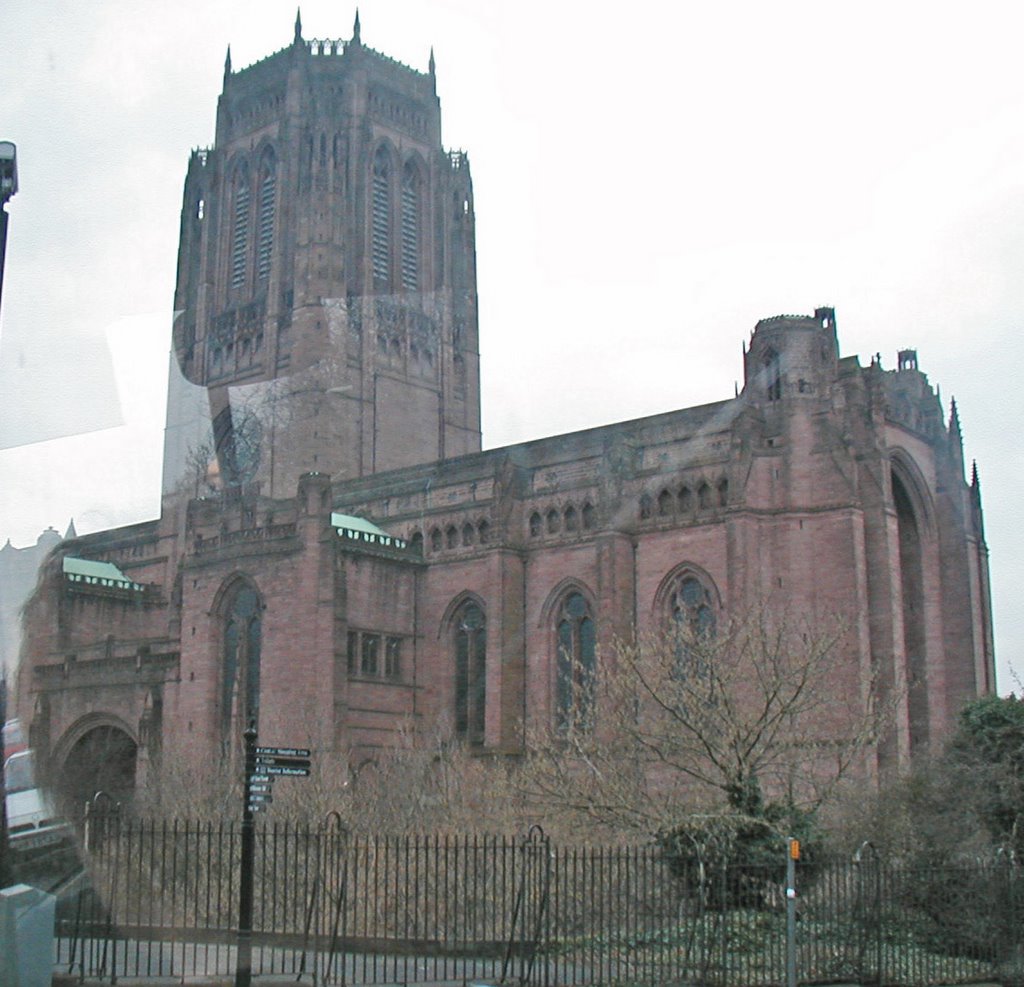
Obligatory history trivia: This most successful musician, and the UK’s first music billionaire, was once a choir boy at his Anglican church in Liverpool. When he auditioned at the much larger Cathedral, indeed the largest Anglican Church in Britain, he was turned down as not talented enough. In 1991, he performed his Oratorio there. The story goes (whether true or not) that when he returned, he saw the old priest who turned him down. When Paul asked if he remembered him and what he’d said, the reply was,
“Yes, and because of it, you went on to become a Beatle!”
There were then photos of the Quarrymen then the Beatles at the 1964 Ed Sullivan Show (I remember watching it) and then Wings. Then various tours followed by the 9/11 concert in NY, Live 8 in Hyde Park, London, and his colossal concert “Live in Red Square,” Moscow. (Back in the 1960s, the Beatles had been forbidden in the Soviet Union.)
Yet another history trivia: When Paul performed his previous tour in Rome, they build a stage over part of the floor of the Coliseum. A historical first!

The show began in earnest 45 minutes late, thanks to security scans of all attendees. And it started with a surprise, though a very logical one – as we were asked to Roll Up, Roll Up For the Mystery Tour
- Magical Mystery Tour
This title track to the album of the same name began with a live lighted stage floor lit up like a pinball machine. It was the most high-tech stage I’d seen. It appears to have been a 24 x 24 matrix of square LCD screens that could display colors and even animated pictures on the flat stage that extended to the back and curved up to a vertical backdrop to the drum set. By the way, the Beatles coach (bus) tour from the Liverpool Tourist Information Center is called The Magical Mystery Tour.

Paul introduced the “US” show with
“We have come for many miles to rock you tonight — and rock you we will!”
The crowd went wild.
The next song was:
- Flaming Pie
This song is from his album of the same name.
- Jet
The bass was overwhelming, even through my earplugs. After too many years of concerts by The Who earplugs have become required.
Paul then said,
“We’re gonna play some new songs and some old songs. The next one definitely falls into the later. If you remember it, you weren’t there.”
- I’ll Get You (in the End)
This is a song he’s never performed live since the Beatles. He followed this with,
“Here’s one we performed at the Super Bowl.”
- (Baby You Can) Drive My Car
There were two lava lamps next to the keyboard set. Foreshadowing?
“We performed in Rock & Roll and Rhythm & Blues clubs in Liverpool. We wanted to do the cabaret clubs — probably because they paid better. But you had to do a smoochier set.”
So he played:
- Till There Was You
This is Paul’s old cover from the musical “The Music Man” this time accompanied by an accordion! And I thought it was the case: Use an accordion, go to jail. It’s not just a good idea; it’s the law!
Abe, his drummer, said,
“Hello Denver, it’s good to be back. You’re looking good. Are you ready to rock?”
Thunderous affirmative from the crowd.
- Let Me Roll It
Which was followed by a guitar riff Jimi Hendrix “Foxy Lady.” Then:
- Got To Get You into My Life
Where the horns, of course, were synthetic, but every note, which is burned into our engrams was perfect.
A piano appears from below the center of the stage. Paul tells us,
“It comes up out of a hole in the stage. On the second night of the tour, I forgot. I stepped back with my bass and fell in. In slow motion, I thought ‘How deep is this hole?'”
- Fine Line
This is the first track of his latest album, Chaos and Creation in the Backyard, which he was careful to point out. Then back to the old hit:
- Maybe I’m Amazed
It’s easier to track the harmonies — a descending progression — with this band for some reason than on the original album. If he can’t hit all the notes anymore, no one minded.
- The Long And Winding Road
Back to his guitar — and he changed guitar between almost every song — for his solo. Back to before the Beatles. A skiffle song. He said how nice it would be to have the 20,000 backing vocals… we were to sing Whoa-aoo-oo-oo.
- In Spite of All The Danger
- (If You Want Me To) I Will
This wonderful song, from the self-titled The Beatles — but better know as simply the White Album — had never been performed live before. He related the story that he’d met a guy in a Mexican restaurant in Pasadena who told about how his daughter had performed it at her school. Paul made a point to perform it live.
His next song was:
- Jenny Wren
This is an unusually beautiful song from his new album, reminiscent of his earlier Blackbird. In a previously published interview, Paul said he’s tried to avoid writing songs that sounded like his Beatles music, but no one else does. If they can rip him off, he can do it too. This one was done to beautiful effect. For this song, he was joined by Abe on the drums — a simple beat — and Wix on the accordion.
He told us it was sometimes to remember the words to his songs when he saw banners being waved in the audience. He mentioned one in particular:
“My mother saw you at Shea Stadium.”
Back to the piano, Paul began to sing A love that should have lasted years.
- For No One
- Fixing A Hole
Here he did a nice solo, with some modifications — it seemed to avoid some high notes. But nobody minded. This was followed by an introduction to one of the prettier songs from his new album:
- English Tea
In it, he mentions, “Miles and miles of English gardens.” Veddy British.
“I am proud that I worked in the word ‘peradventure.’ I looked it up in the dictionary. It means ‘maybe.’ You don’t expect to come to a show like this and learn something like that. I understand that the word is now sweeping the nation.”
“I remember writing the following song in our little place in Liverpool.”
- I’ll Follow the Sun
He did the last line 3 times
“It’s such a short song that I need to do it again,”
so he did.
“Enough’s enough!”
but the crowd wanted more, so he did it yet again.
“I’d like to dedicate this next song to my lovely wife and our child.”
- Follow me (you lead me to places I’ve never been)
While this sounds like a very personal song, I couldn’t help thinking that it also sounds like an Adam Sandler tune. Nevertheless, the LCD floor fired up with sparklers cascading in the back.
“Back in Liverpool, George and I would play this song. It was semi-classical. It was actually classical, but we made it semi. It was by J.S. Bach. I took it and years later turned it into this”
- Blackbird
As he sang and played, one could see on his left wrist he wore two white “Lance Armstrong” style bands.
- Eleanor Rigby
- Too Many People
- She Came In Through the Bathroom Window
The crowd went crazy for this last tune. Then he related that with this next song, NASA woke up the space shuttle with the following song:
- Good Day Sunshine
Since this concert, his Anaheim concert was beamed into space to entertain the international space station, ISS Expedition 12, to share with them this song and “English Tea.” However, this time the astronauts were awakened from sleep not by recorded music, but by live music, a first.
- Band on The Run
I noticed that each front stage performer had 2-floor monitors — unusual in the day of in-ear monitors — but Paul had 3.
- Penny Lane
Penny Lane is a street in Liverpool, where John and Paul were once waiting in a one-story building in the middle of the roundabout (rotary for us Yanks) and saw a “banker on the corner,” and “a barber.”

Me at Penny Lane, Liverpool
This was followed by:
- I’ve Got a Feeling
“Oh, I got a feeling…”
Paul said, and when the jet sound came up, and you just knew it was going to be:
- Back in the USSR
“Those Ruskies love their Rock. We did it in Red Square,”
Paul said.
During the concert, it was more sad than amusing to watch two hyperactive middle-aged women, whose lack of rhythm was rivaled only by their inability to dance, stand up in front of me to rock and/or roll.
Back again to the piano, where they started to sing:
- Baby Face
The crowd seemed confused until it was abruptly ended with,
“Sorry, wrong tune… Here it is:”
- Hey Jude
Many in the crowd came to their feet for the chorus. Paul asked for participation in singing from the top, the floor, men only, women only, then everyone.
But last time, everyone was on their feet singing. The real crowd-pleaser followed:
- Live and Let Die
with real multi-colored flames. Shades of the Wizard of Oz. What a way to end a show.
Obligatory movie trivia: At his Denver concert in 2002 there were 007 photo clips including Sean Connery, despite the fact that this was a Roger Moore Bond movie. It is ironic that Paul McCartney wrote the theme to a James Bond movie. In 1964’s Goldfinger, Sean Connery chides his golden girl Jill Masterson when the champagne loses its chill with “My dear girl, there are some things that just aren’t done, such as drinking Dom Perignon ’53 above the temperature of 38 degrees Fahrenheit. That’s just as bad as listening to the Beatles without earmuffs!”
He left the stage, only to return for his first encore:
- Yesterday
- Get Back
with the whole band.
“Thank you, Denver. I’ve got a feeling you still want to rock.”
- Helter Skelter
Another encore had Paul returning to the stage in his red t-shirt, “No More Landmines.” The band was waving flags: US, Colorado, and others.
- Please Please Me
But it was not like the original harmonies with John Lennon.
Paul then took down house lights and lit one candle on the piano to sing:
- Let It Be
They ended with a fabulous:
- Reprise from Sgt Pepper/Abbey Road Riff/The End
A satisfying show ended at 11:30 pm. But was it as good as the last concert in 2002? It may have rivaled it, but it did not compare. This one was a home run. But the previous concert, the best I’d seen was a grand slam. But a home run isn’t bad. I could have used more of his Beatles music. But couldn’t everyone?
Perhaps you can only see Paul McCartney the first time, once. This concert had fewer “off” songs than the previous concert. “C Moon” what was with that? And the new songs from his new album were not only almost consistently good but, in a few cases, rivaled the quality of his writing from the days of The Beatles.
At 63, it is understandable that Paul’s higher range might not be what it used to be, but I hope he comes back next year and sings to us “When I’m Sixty-Four.”
We’ll still need him, we’ll still feed him, when he’s sixty-four.
Bill Petro, your friendly neighborhood Beatle maniac
https://www.billpetro.com/
 HISTORY OF OCTOBER 31
On October 31, 1517, an Augustinian monk named Martin Luther nailed to the door of the Castle Church in Wittenberg 95 propositions or theses and marked the beginning of the Reformation. Of course, the Reformation began long before that, but this date proves to be a convenient coat hanger to mark the beginning of Protestantism. But the 95 Theses were not intended as a call to reformation and it is the story behind this event that proves so fascinating, and shows the real purpose of the 95 Theses.
Prince Albert wanted the archbishopric of Mainz. (You may know Mainz as the home of a goldsmith named Johann Gutenberg, who had developed the uniform-sized movable type printing press 60 years earlier.) Because Albert was less than 25 years old, the office of archbishop would cost him $500,000. Pope Leo X, who was financing the building of St. Peter’s in Rome (for $46 million) suggested that Albert borrow the money from the wealthy Fugger banking family. Albert was able to secure half the funds from the Fuggers, and for the rest he sold indulgences. An indulgence was a document which freed the holder from the temporal penalty of sin. The sale of indulgences, introduced during the Crusades, remained a favored source of papal income. In exchange for a meritorious work – frequently, a contribution to a worthy cause or a pilgrimage to a shrine – the church offered the sinner exemption from his acts of penance by drawing upon its “treasury of merits.” This consisted of the grace accumulated by Christ’s sacrifice on the cross and the meritorious deeds of the saints. In Castle Church at Wittenberg for example, it was believed that the relics (bones of saints, etc.) were reckoned to earn a remission for pilgrims of 1,902,202 years and 270 days.
When the Dominican John Tetzel came preaching through much of Germany on behalf of Albert, he boasted that for a contribution he would provide donors with an indulgence that would even apply beyond the grave and free souls from purgatory. “As soon as the coin in the coffer rings,” went his jingle, “quickly the soul from purgatory springs”.
To Martin Luther, the professor of biblical studies at the newly founded University of Wittenberg, Tetzel’s preaching was bad theology if not worse. Luther thought this practice was wholly unwarranted by Scripture, reason or tradition. It encouraged not repentance but mere payment. Luther promptly drew up 95 propositions or theses in Latin, following university custom, for a call to theological debate. Among other things, they argued that indulgences cannot remove guilt, do not apply to purgatory, and are harmful because they induce a false sense of security in the donor. The 95 Theses were not a general call to break with the Roman Catholic Church. The irony is that someone took the 95 Theses and translated them into German, the language of the common man. And with the aid of the printing press copies were distributed to the masses. This was the spark that ignited the Reformation.
Bill Petro, your friendly neighborhood historian
www.billpetro.com/holidayhistory
 HISTORY OF HALLOWEEN
Halloween (Allhallows Even) is the evening of October 31. In its strictly religious aspect, this occasion is known as the vigil of Hallowmas or All Saints’ Day, November 1, observed by the Roman Catholic and Anglican churches. In the fourth decade of the 8th century, Pope Gregory III moved this holiday to the present date (from May 13) for celebrating the feast when he consecrated a chapel in St. Peter’s Basilica in Rome to all the saints. Later, Gregory IV extended the feast to the entire church in 834. In Latin countries in Europe the evening of October 31 is observed mainly as a religious occasion, but in Great Britain, Ireland, and the United States, ancient Halloween folk customs persist alongside the ecclesiastical observance.
Halloween is the second most popular holiday in the U.S. after Christmas — at least according to retailers — but it is the first in terms of candy sales. Not only are candy and costumes popular purchases, but increasingly, houses are being decorated with "Halloween lights." Parties are popular and are increasingly being celebrated the weekend before. In Boston, for example, Salem is a popular location for these with its month-long Haunted Happenings celebrations — due to the Salem Witch Trials of 1692 — and the Massachusetts Turnpike traffic signs point out that Salem can be reached from Boston via Route 1A North. In Tokyo, I’ve seen young people dress up in western-style costumes during Halloween, especially in the Harajuku district along the shopping area on Takeshita-dori Street.
(more…)
 ROSH HASHANA
Rosh HaShana designates the beginning of the Jewish new year. “Rosh” is Hebrew for “head” and Rosh HaShana refers to the head of the year on the 1st day of Tishri, the seventh month. Judaism has a solar/lunar calendar system, in which the lunar reckoning predominates. The first in the cycle of months is Nissan (which has nothing to do with the automobile manufacturer), the month in which Passover occurs. However, solar years are reckoned to begin at Rosh HaShana. The new year is heralded with the blowing of the “shofar” or ram’s horn by the “baal t’kiah” (meaning master of the shofar-blast). Some scholars have suggested (perhaps “speculated” would be a better word) that the Jews marked the beginning of the year at this time subsequent to the period of their Babylonian Captivity, in following with the Babylonian custom. It also marks the day on which God is said to begin examining the record of each person’s actions during the preceding year; Jews are called upon to take an “accounting of the soul” with the aim of correcting defects in one’s behavior — the ultimate goal is to help “repair the universe.” The audit is considered to end on Yom Kippur, on the 10th day of Tishri, which we will examine next time.
Bill Petro, your friendly neighborhood historian
www.billpetro.com/holidayhistory