History of October 31: What’s Martin Luther got to do with it?

Wittenberg Door
HISTORY OF OCTOBER 31: MARTIN LUTHER
See my miniseries on the life of Martin Luther.
On October 31, 1517, the Augustinian monk Martin Luther nailed 95 propositions or theses to the door of the Castle Church in Wittenberg, Germany, marking the beginning of the Reformation.
Of course, the Reformation began long before that, but this date is a convenient “coat-hanger” for historians to mark the beginning of the Protestant* Reformation.
However, the 95 Theses were not intended as a call to reformation, and the story behind this event is fascinating and reveals their real purpose.
Fund Raising and the Vatican
Prince Albert of Brandenburg wanted the archbishopric of Mainz. You may know Mainz as the home of goldsmith Johann Gutenberg, who developed the uniform-sized movable-type printing press some 60–70 years earlier. Because Albert was under 25 and holding multiple archbishoprics was forbidden, the archbishopric required a dispensation that would cost him 23,000 ducats (about $500,000).

Jacob Fugger. Image: Wikipedia

Pope Leo X, who was then financing the refurbishing of St. Peter’s Basilica in Rome (for $46 million), suggested that Albert borrow the money from the wealthy Fugger banking family in Augsburg. Albert secured half the funds from Jacob Fugger, banker to the Pope and the Habsburg Dynasty, and raised the rest by selling indulgences.
What Are Indulgences?
According to Roman Catholic doctrine, an indulgence was a document that freed the holder from the temporal penalty of sin. The Roman Catholic Church originally introduced the sale of indulgences during the Crusades, and it remained a favored source of papal income. In exchange for a meritorious work – often, a contribution to a worthy cause or a pilgrimage to a shrine – the Roman Church offered the sinner exemption from his acts of penance by drawing on its “treasury of merits.”
According to the Roman church’s doctrine of ex opere operato (“by the work worked”), this “treasury” consisted of the superabundance of grace accumulated by Christ’s sacrifice on the cross, along with the meritorious deeds of the saints. The Pope dispensed this surplus to sinners. For example, at the Castle Church in Wittenberg, it was believed that the relics (bones of saints or other articles from biblical characters) collected there were reckoned to earn pilgrims 1,902,202 years and 270 days of remission from Purgatory.
Indulgence Sale
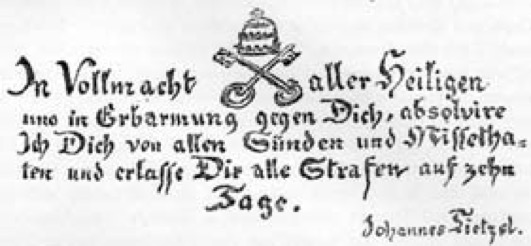
Tetzel’s Indulgence. “In the authority of all the saints, and in compassion towards thee, I absolve thee from all sins and misdeeds, and remit all punishment for ten days.” Source
The Dominican friar John Tetzel preached across much of Germany on behalf of Albert; he boasted that, for a contribution, he would grant donors an indulgence that would even apply beyond the grave and free souls from Purgatory.
Purgatory, according to the Roman Church, is a passing intermediate state after physical death for purifying or purging a soul.
Tetzel even had a German marketing slogan:
Sobald der Pfennig im Kasten klingt,
die Selle aus dem Fegfeuer springt.
In English:
“As soon as the coin in the coffer rings,
“Quickly the soul from Purgatory springs.“
Reformation Reaction
To Martin Luther, the professor of biblical studies at the newly founded University of Wittenberg, Tetzel’s preaching was bad theology, if not worse. His parishioners were not coming to him for Confession, informing him that they’d already “paid” for their sin. Luther thought this practice was wholly unwarranted “by Scripture, reason, or tradition.” He felt it encouraged mere payment rather than repentance. Luther promptly drew up 95 propositions, or theses, in Latin, following university custom, to call for theological debate.
Among other things, the 95 Theses argued that indulgences could not remove guilt, did not apply to Purgatory, and were harmful because they gave donors a false sense of security. So, the 95 Theses were not a general call to break with the Roman Catholic Church. Instead, he intended to begin his debate on the theses, or “The Disputation on the Power and Efficacy of Indulgences,” by discussing the sale of indulgences and the biblical limits of Papal power.
Printing Press and the Reformation
Ironically, his friends, to whom he had sent private copies, took the 95 Theses and translated them into German, the common people’s language. Using Gutenberg’s printing press, copies were distributed to the masses, and it went viral. This wasn’t what Luther originally intended; it was like hitting “reply all” and being unable to recall it.
Historians consider this event to be the “spark” that ignited the Reformation. Consequently, many Protestant churches celebrate October 31 as “Reformation Day” and the nearest Sunday before it as Reformation Sunday. On that day, Luther sent his 95 Theses to his superior, the aforementioned Albert of Brandenburg, now the Archbishop of Mainz, in whose name the indulgences were being sold, humbly to bring it to his attention. However, Luther did not know about Albert’s involvement in the indulgence sales, as mentioned above.

Luther nailing the 95 Theses to the Wittenberg Door, by Greg Copeland, from Paul Maier’s Martin Luther: A Man Who Changed the World.
And Luther also nailed them to the northern wooden door of the Castle Church in Wittenberg. Probably. Luther never wrote about the “The Door” episode, though his close friend and fellow professor, Philip Melanchthon, reported it decades later. But Melanchthon wasn’t a witness; he was out of town that day. However, a call to debate would have been posted to the door then, or in the middle of November.
New Light on an Old Mystery
In 2006, a discovery was made: Luther’s secretary Georg Rörer‘s handwritten comment was found. At the end of the desk copy of the 1540 revision of Luther’s (translation into German of the original Greek) New Testament appeared Rörer’s note:
“On the evening before All Saints’ Day [October 31] in the year of our Lord 1517, theses about letters of indulgence were nailed to the doors of the Wittenberg churches by Doctor Martin Luther.”
Curiously, it mentions plural churches, suggesting that all the half-dozen churches in Wittenberg carried the call to debate – all in Latin.
So…
Did Luther “nail” the 95 Theses to the Wittenberg door? Did he attach them with thumbtacks or a hammer? Over the years, I’ve noticed pictures depicting the hammer’s size have grown from a ball-peen hammer to a claw hammer, to a mallet, to a sledgehammer the size of Thor’s mystic hammer, Mjölnir. But Luther did mail the 95 Theses on October 31. Probably using a hammer.
* P.S. “Protestant”

The Imperial Cathedral Basilica of the Assumption and St Stephen. Image: Wikimedia

Of course, 1517 wasn’t the actual beginning of the use of the word Protestant. That didn’t occur until over a decade later. In 1526, the Diet of Speyer met to address the earlier Imperial Edict of Worms (1521), which had politically condemned Luther. The Diet held that “every State shall so live, rule, and believe as it may hope and trust to answer before God and his Imperial Majesty.”
However, practically, it turned out that each German state (Prince) took it to grant freedom to choose its own allegiance:
“As goes the religion of the Prince, so goes the people.”
In 1529, at the Second Diet of Speyer, the Edict of Worms condemnation was reaffirmed, essentially re-condemning Lutheranism. Half a dozen Lutheran princes presented a formal “Letter of Protestation,” which was subsequently printed and made public, and so were they called “Protestants.”
Bill Petro, your friendly neighborhood historian
billpetro.com

Its really great sir.. We can say the foundation of Modernism…
Indeed, it has been said that Martin Luther was the last medieval man, and the first modern man. And in church history, this was the dawn of the Early Modern period.
-Bill
enjoyed the post!
Don’t let Halloween overshadow Martin Luther’s 95 Theses!
https://billpetro.com/history-of-october-31
Michael Eayrs liked this on Facebook.
Chuck Dunn liked this on Facebook.
Ian Millar liked this on Facebook.