History Articles
 HISTORY OF THE SANHEDRIN


The Greek word Συνέδριον, sunedrion, means literally “sitting together” and is usually translated as “council.” The New Testament refers to it alternately as “the Great Law-Court,” “the Court of Seventy-One,” and “the rulers and elders and scribes.”
It was the supreme theocratic court of the Jews. The Sanhedrin reflected the local autonomy that the Greek and, later, the Roman powers granted the Jewish nation during their successive sovereignty over the Land of Israel.
What was its origin, what was its makeup, what were the political persuasions of its members, what was its role in the life of the Jewish people?
 HISTORICAL CLIMATE OF EASTER

As Passion Week begins this weekend, what was the historical climate of Easter Week almost 2,000 years ago surrounding the last week of the life of Jesus of Nazareth?
All men die; Jesus was a man destined to die, not merely in the conventional sense but in a distinct and peculiar manner.
Jesus entered Jerusalem amidst a tumultuous environment characterized by religious, political, military, social, and economic upheaval.
At that time, events in ancient Israel were rarely linked to the broader context that governed the province: the Roman Empire. Nevertheless, Jesus’ career culminated in a “tale of two cities” – Jerusalem and Rome. The political and military might of Rome affected the culture and legal system in Jerusalem. In this series on Easter, we’ll discuss:

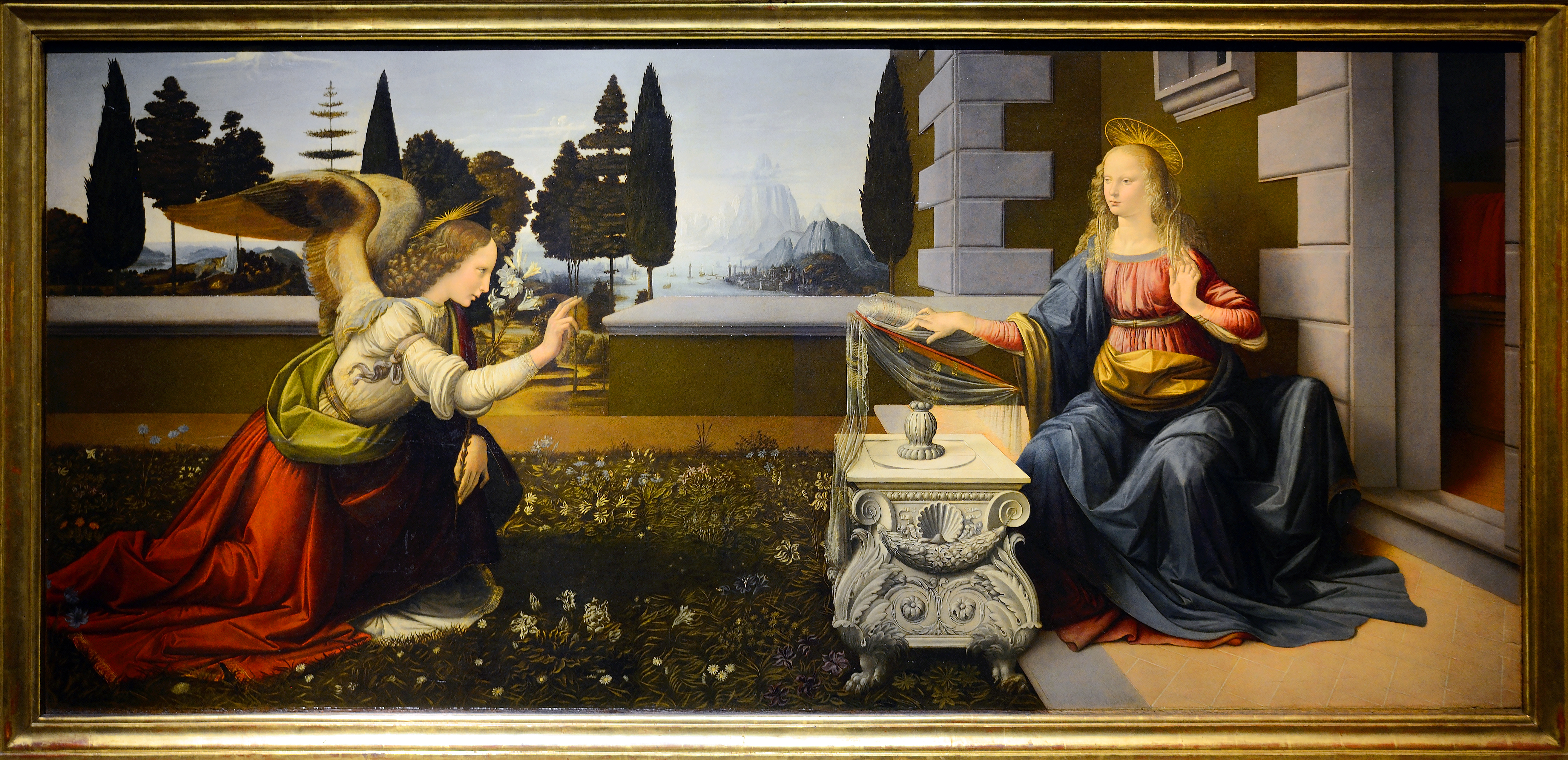
Annunciation, by Leonardo da Vinci. Image: Wikipedia
History of Annunciation Day
Annunciation Day or the Feast of the Annunciation is a commemoration of the visit by the archangel Gabriel to the Virgin Mary to announce that she would be the mother of Jesus Christ, the Son of God.
March 25 marks the celebration, unless it falls on either:
- Holy Week (the week starting with Palm Sunday and concluding on Holy Saturday) or
- Easter Week, sometimes used interchangeably with Holy Week, but more precisely, the week that includes Easter Sunday.
Otherwise, Annunciation Day, or Lady Day, is postponed to the Monday after the Second Sunday of Easter.
Who observes this holiday, what’s the biblical origin, and how is it related to a famous prayer?

Project Hail Mary movie poster. Image: Wikipedia
Movie Review: Project Hail Mary (no plot spoilers)
The most anticipated movie of 2026 has been Project Hail Mary. Amazon has spent about $200M on the film, and I think it’s going to be money well spent. It has grossed an estimated $33.1 million on its opening day, including $12 million from Thursday previews and early access screenings. Forecasts are on track for a domestic opening weekend of between $63M to $77M.
Update after the weekend:
The film earaned $80.5M at the domestic box office, $141M globally — the second-biggest debut for a non-franchise movie after “Oppenheimer.”
Without giving away any of the plot, I can say that I believe it’s the best movie of the year, so far. In fact, I think it’s the best movie I’ve seen in a year. The reviews so far have been overwhelmingly positive.
Reading Time: 5 minutes
SCIENCE OF THE SPRING
In Colorado, we have a saying:
“We begin the first day of Spring like we began the Fall: with snow.”
This symmetry is relevant because the beginnings of Spring and Fall coincide with the Equinox.
This word consists of two Latin root words, aequus and nox, meaning “equal night,” referring to the fact that daylight and nighttime are equal in duration.
Reading Time: 4 minutes

St Joseph with the Infant Jesus, Guido Reni, c 1635. Image: Wikipedia
HISTORY OF ST JOSEPH
March 19 is Saint Joseph’s Day, or the Feast of St. Joseph. It is celebrated by the Roman Catholic, Anglican, and Lutheran Churches worldwide. The terms feast and festival are often used interchangeably and often refer to a religious holiday.
What is the history of the holiday and Joseph himself?
Reading Time: 5 minutes

St. Patrick. Photo by K. Mitch Hodge on Unsplash
HISTORY OF ST. PATRICK
Although much of the life of the patron saint and Apostle of Ireland is shrouded in legend, St. Patrick was probably born around AD 389. Stories are told of Patrick’s many contests with Druids, pagans, and polytheists, as well as the well-known but curious story of him driving the snakes from Ireland. More on that later.
What we know about him comes from his memoir, Confessio, which he wrote near the end of his life. It begins,
“I, Patrick, a sinner, most uncultivated and least of all the faithful and most contemptible to many, had for father the deacon Calpurnius, son of the late Potitus, a priest, who was of the village of Bannavem Taberniea.”
Reading Time: 4 minutes
 HISTORY OF THE IDES OF MARCH
According to the ancient Roman calendar, the ides fell on the 13th of the month except for March, May, July, and October, when it fell on the 15th.
Something epochal occurred on the Ides of March in 44 B.C.
Reading Time: 3 minutes
 HISTORY OF PI DAY



This holiday is often overlooked by those who do not speak Greek or those who do not speak Geek… but for the science major, this is a special celebration. Though it is an irregular constant number, we have the first three digits of “Pi” regularly and annually on March 14, or 3/14, or 3.14.
If one wanted to be precise, and why not, it would be at 15:92 o’clock or 4:32 pm… and 65.35 seconds, or slightly after 4:33 pm, because pi=3.141592… You get the idea.
Reading Time: 4 minutes
 HISTORY OF FRIDAY THE 13TH
If you’re reading this article to learn the history of Friday the 13th, you’re in luck.
Or perhaps bad luck.
No one knows, with any certainty, when it began or why it’s to be feared. However, there are lots of entertaining speculative theories about the topic.
 HISTORY OF THE 40 MARTYRS OF SEBASTE
A remarkable event took place in the early 4th century Roman Empire. The early church historian Bishop Eusebius tells the story of his contemporary, the Roman Emperor Constantine, who, before a battle against his rival Emperor Maxentius in 312 AD at the Milvian Bridge outside of Rome, had a dream (or vision) that he was to conquer in “the sign of Christ.”

Saving Daylight Mobilize an Extra Hour of Daylight. Image: Wikimedia

HISTORY OF DAYLIGHT SAVING TIME
It seems like only yesterday that we discussed the ending of Daylight Saving Time, or DST, a brilliant campaign to convince people that we’re getting more daylight each day when, in reality, they’ve simply changed their clocks and then forgotten about it within two weeks. It was only back in November, four months ago.