History Articles
 HISTORY OF WIFI DAY: 8.02.11
Today is August 2, 2011… or 8.02.11. This number is also the designation for the popular WiFi standard in use today.
The IEEE 802.11 standard refers to a set of protocols for Wireless Local Area Networking, or WLAN, and is popularly known as WiFi or colloquially as “Wireless Fidelity” like Hi-Fi, though WiFi doesn’t really stand for anything. In common parlance, it is what allows your mobile computing device — whether it be a smartphone, a tablet, or a computer — to connect without wires to a local “hot spot.”
 HISTORY OF 2011: A NEW DECADE?
As the chronometer clicked over from 2009 to 2010 last year, many heralded the end of the first decade of the millennium and the beginning of the next, regaling the best and worst at the end of the first decade of the 21st century.
Except that it wasn’t.
Last year I argued that clicking over to 2010 did mark the end of a decade — indeed any year is the end of a 10 year period preceding it — and it certainly was the beginning of “the decade of 2010s” as any year is the start of a 10 year period following it. And of course, it was the end of the “aughts,” the ’00s in the same way as 1970 was the end of the ’60s. While this term is not used as commonly as at the beginning of the 1900s, we came to the end of “Aught 9.”
 HISTORY OF 10-10-10
Consider the date October 10, 2010 or for those in Europe and elsewhere 10 October, 2010 depending on where you live. In either case, the numbering of the date is the same: 10-10-10. This kind of numbering hasn’t happened in over a year since 09-09-09, and won’t happen again for at least another year or 11-11-11, making it an epochal event.
For the mathematicians in the audience, the date is Binary for:
[(1) x 25] + [(0) x 24] + [(1) x 23] + [(0) x 22] + [(1) x 21] + [(0) x 20] =
[1 x 32] + [0 x 16] + [1 x 8] + [0 x 4] + [ 1 x 2] + [0 x 1] =
32 + 8 + 2 =
42
…which is, of course, intuitively obvious to the most casual observer — although some do have an on again, off again, on again, off again, on again, off again attitude toward Binary.
 The author Douglas Adams has suggested that while 42 is:
“a completely ordinary number, a number not just divisible by two but also six and seven. In fact it’s the sort of number that you could without any fear introduce to your parents.”
But he also pointed out in the 3rd book of his 5-volume science fiction trilogy The Hitchhiker’s Guide to the Galaxy that this number was indeed the ultimate answer to Life, the Universe and Everything. Everyone should know this, if not, go type the answer to life, the universe and everything into Google. I’ll wait.
But what is the question itself?
Bill Petro, your favorite neighborhood historian
www.billpetro.com
If you enjoyed this article, please consider leaving a comment, or subscribing to the news feed to have future articles delivered to your feed reader, or to your email.

HISTORY OF THE IPAD
Question: How can you have a “history” of a device that was just announced today?
Answer: This has been the longest anticipated unannounced product in history, or at least Apple history. It has been a veritable speculation-o-rama.
Question: I don’t get the iPad. Isn’t it just like a giant iPhone?
Short answer: Yes, it’s essentially a large iPhone but without voice phone capabilities.
Long answer: I believe the iPad is the computing platform of the future. The iPhone is a great smartphone, but the screen is too small to type (very much) on, and the screen will give you a headache if you watch a full-length movie on it. It’s possible but painful to read a book on it. Nevertheless, it’s incredibly portable.
Laptops (MacBooks) are as powerful as a desktop computer, but too big and too heavy to carry around practically, without a briefcase. I’ve got a 15″ MacBook Pro, and I love it, but it’s still a pain to drag around.
But the iPad is a carry-able device. Lighter than any netbook (which is an underpowered laptop, which itself is a miniature desktop) and the size of the Kindle DX; it’s got 10 hours of battery and leverages both WiFi and 3G data networks for Internet connectivity.
I recently Tweeted about this back on January 1:
My Apple “Tablet” prediction: it’ll be less of a sub-MacBook, and more of a super-sized iPod Touch. Internet’s becoming ubiquitous.
This uses the iPhone OS: gesture-based (multi-touch), not a folder-based desktop like Windows — but App based, like the iPhone. A veritable infotainment device. Excellent for consuming music, photos, new games, video (viewable movies!), large screen newspapers, magazines… and now books. Apple will open a third online store after iTunes and the App Store — this one is the iBookstore. Five publishers — Penguin, HarperCollins, Simon & Schuster, Macmillan, and Hachette Book Group — have already signed on. iBooks will use the ePUB standard, a free and open book standard.
This could indeed be a game-changing device, ready to open (or revitalize) markets. As the iPod was not the first digital music player, and the iPhone was not the first smartphone, each in its own way changed the market, indeed redefined it. The iPad could do the same, especially for content creators.
Tablet computers have up until now gained only single-digit market share. How will the new Apple tablet do?
Question: So, what about the Kindle?
Answer: If I were a Kindle DX, only $10 cheaper than the entry-level iPad, I’d be saying “Dead Man Walking.” While the smaller sized $259 Kindle is currently half the price of the iPad, the iPad has a full screen, color, runs 140,000 iPhone apps… and it’s a 1GHz computer! It’s not a single-use device. (OK, the Kindle can do some limited Internet activities.) And it’s while it’s got a virtual pop-up keyboard, it’s also got an available physical keyboard that you can attach via a Keyboard Dock to the iPad. There is also a standalone iPad Dock that serves as a viewing kickstand.
Interestingly, the iPad has no camera, USB connector, or SD expandable storage slot, like the MacBooks and iMacs. Instead, it has adapters that allow SD cards to plug in for photo transfer. So, with no direct connectors, is this an early “cloud” device?
Either way, I think this is the computing platform of the future.
Question: Why do you think it’s the platform of the future?
Answer: Having been to the future (I just got back) here are the devices that will be used. Back in the 1950s, Isaac Asimov published the Hugo Award-winning science fiction trilogy Foundation. In the distant future about eleven thousand years from now, our hero Hari Seldon, the gifted psychohistorian (that’s why I studied history!) was able to predict the future in terms of large scale human conglomerate socio-mathematical probabilities as he did his calculations on a flat-panel device that he kept in a pouch at his belt. It was more than a calculator, a pad really, but less than what we’d call a laptop.
“Men said he kept one beneath his pillow for use in moments of wakefulness. Its gray, glossy finish was slightly worn by use. Seldon’s nimble fingers… played along the hard plastic that rimmed it.”
Question: What’s with the name iPad? Think of the jokes. What happened to iSlate, iTablet, iSlab, iAppleNextThing?
Answer: I like the name iPad. Admittedly, Apple Store employees are going to be saying “Were you asking about the iPod or the iPad?” But the name iPod is more iconic than descriptive. iPad is like a notepad, something that you commonly carry with you.
And it reminds me of the portable computer devices used in Star Trek: The Next Generation, called the PADD, the Personal Access Display Device, a hand-held, flat-panel, touch-screen computer interface, These will be used as early as the 22nd century. They (will) come in various sizes and have different functions.
Question: What about the price?
Answer: We knew that it would fall between $299 and $999? Why? The high-end iPhone is $299, and the low-end MacBook is $999. Apple (likely) leaked the $999 price prior to the announcement to test the waters. $499 for the entry-level iPad is cheaper than I’d expected. But you get limited memory (16GB) and no 3G connectivity. Memory is always a premium “add-on” from Apple, and the high-end 64GB version, with 3G, is $829. That seems rather steep for a non-laptop device.
Question: 3G or not 3G?
Answer: Apple provides the choice between WiFi only, and WiFi plus 3G. What’s the difference?
- WiFi only makes this an iPod Touch type of device, with the same use cases. Meaning great at home, Starbucks, Paneras, McDonald’s — anywhere there is a WiFi hotspot. But the good news is you have no monthly subscription service to a phone company.
- Wifi plus 3G makes this an iPhone type of device, usable anywhere you have data cellular coverage. This makes it considerably more mobile, at least until WiFi becomes more ubiquitous, but at a price. $30/month to AT&T for unlimited data is less than a phone plan, but you also won’t be using it as a voice phone.
Want one? The line forms to the rear.
Bill Petro, your favorite neighborhood historian
www.billpetro.com
HISTORY OF 2010: A NEW DECADE?
As the chronometer clicks over from 2009 to 2010, many are heralding the end of one decade and the beginning of another, regaling the best and worst at the end of the first decade of the 21st century.
Except that it isn’t.
Clicking over to 2010 does mark the end of a decade, indeed any year is the end of a 10 year period preceding it, and it is certainly the beginning of “the decade of 2010s” as any year is the start of a 10 year period following it. And of course, it’s the end of the “aughts,” the ’00s. While this term is not used as commonly as at the beginning of the 1900s, we’re coming to the end of “Aught 9.”
But it is not the ending of THE decade, at least not the end of the first decade of the 21st century. Why is that?
In the same way that the year 2000 was not the beginning of the 21st century, 2010 is not the beginning of the second decade of the 21st century. I know what you’re thinking:
“But wait, didn’t every major capital city in the world have celebrations on December 31, 1999 to usher in the year 2000? Wasn’t the Eiffel Tower lit up like a Roman candle… or at least a French candle?”
 True enough, but the calendar did not start with the Year 0, and so 2000 was not the beginning of the 21st century. That’s why Arthur C. Clarke entitled his science-fiction epic 2001: a space odyssey. He wanted to mark the beginning of the Third Millennium, the correct start of the 21st century. You’re probably protesting:
“Then why did we make such a big deal out of the Year 2000?”
And well you might ask. Have you ever watched your odometer click over from 1999 to 2000? But that’s only part of the answer. At least equally powerful a motivation was that the year 2000 was the end of the Y2K scare, when we expected that a computer time coding issue would cause the end of civilization as we know it.
Officially, according to the current dating system — which has been in use for simply ages — dates started with Year 1 or AD 1, Anno Domini, (in the year of our Lord) which immediately followed 1 BC, or Before Christ. There was no Year 0. The fact that Jesus was born neither in Year 0 nor Year 1 but at least 4 years earlier we’ve discussed previously. By now you’re probably thinking:
“Didn’t it seem odd to people at the time that one year it’s 1 BC, and the next year it’s AD 1?”
You would think so, except of course, they weren’t using the current Gregorian Calendar that we now use, rather the Julian Calendar, named after that famous Roman Julius Caesar who subsequently got a month named after him. The Romans counted from the “founding of the City (of Rome),” ab urbe condita or A.U.C, about 753 BC. So AD 1 would have been 754 A.U.C. (Although, just between you and I, the Romans preferred marking their calendars by what year it was under the reign of the current consul in government.)
Still with me?
 So, when New Year’s Day comes in 2010 it won’t be the beginning of the second decade of the 21st century. Instead, that will start in 2011.
In any event, what will you start saying:
“Two thousand ten” or Twenty-ten”?
Bill Petro, your friendly neighborhood historian
www.billpetro.com
[icegram messages=”23559″]
 SCIENCE OF THE WINTER SOLSTICE
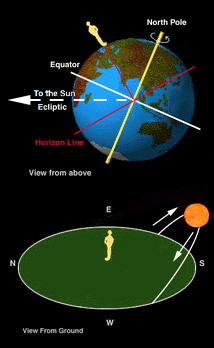
As we’ve mentioned before, the Romans celebrated a holiday known as the Saturnalia beginning on the Winter Solstice. The word Solstice comes from the Latin “solstitium” meaning “Sun, standing-still.” This year it will occur on December 21 at 12:47 pm EST (17:47 GMT.)
Earth enjoys different seasons because the planet is tilted 23 degrees and 27 minutes off the perpendicular to the plane of orbit. This means that the earth revolves like a tilted spinning top. The Winter Solstice is the shortest day of sunlight as the Sun is at its lowest arc in the sky, at least in the Northern Hemisphere. The farther north one is from the Equator, the more pronounced this is in Winter. However, as the Earth continues its orbit, the hemisphere that is angled closest to the sun changes, and the seasons are reversed.
In the Northern Hemisphere the sun appears at its lowest point in the sky, and its noontime elevation appears to be the same for several days before and after the solstice, so that it looks like the Sun is “standing still” until following the Winter Solstice, the days begin to grow longer and the nights shorter.
Bill Petro, your friendly neighborhood historian
www.billpetro.com
 THE HISTORY OF THE TWELVE DAYS OF CHRISTMAS
The Twelve Days of Christmas are the dozen days in the liturgical calendar of the Western Church between the celebration of the birth of the Christ Child (Christmas, December 25) and the coming of the Magi to visit at his house in Bethlehem (Epiphany, January 6). The Eastern Orthodox Church celebrates during Epiphany rather than Christmas Day. In Hispanic and Latin American culture, January 6th is observed as Three Kings Day, or simply the Day of the Kings.
Question: Aren’t the Twelve Days of Christmas the days before Christmas, when you shop for presents?
Answer: No, the four week season before Christmas is called Advent, meaning “the coming” of Christ. The dozen days following Christmas are the Twelve Days of Christmas, sometimes known as Twelfth Night. The Twelfth Night is the holiday which marks the twelfth night of the Christmas Season, the Eve of Epiphany. During the Tudor period in England, the Lord of Misrule would run the festivities of Christmas, ending on this Twelfth Night. Shakespeare‘s play by the same name was intended to be performed as a Twelfth Night entertainment and was first performed during this time in 1602.
This festival was particularly popular during the Middle Ages especially in England, where some of the traditions were adapted from older pagan customs. Modern Neopaganism celebrates this time. This period is also called Yule or Yuletide, which while it serves as an archaic term for Christmas, hearkens back to earlier German and Norse traditions.
Question: But wasn’t this song used as a memory aid for catechism by Catholics in England during the period 1558 until 1829, when Parliament finally emancipated Catholicism there, who were prohibited from ANY practice of their faith by law – private OR public — where each gift is a hidden meanings to the teachings of the faith?
Answer: This is unlikely for several reasons:
At first glance, there is nothing in this song that is uniquely Catholic in belief as compared to Protestant catechism. Any of the items in it could be embraced by Catholic and Protestant alike. While Queen Elizabeth I’s “Act of Uniformity” truly did abolish the “old worship,” and the open practice of Catholicism was forbidden by law until Parliament passed the Catholic Emancipation Act in 1829, nothing in this song would have been taken as particularly Catholic or offensive to Anglican sensibilities. Indeed, during the highly Puritan time of the Commonwealth between 1649 and 1660 under the Cromwell government, Christmas was not celebrated in England until the time of Charles I and the restoration of the English monarchy.
Secondly, while there are differences between Anglican (Protestant Church of England) and Catholic belief, none of those show up in the “hidden meaning” of the song, with the possible exception of the number of sacraments.
However, it may be possible that this song has been confused with another song called “A New Dial” (also known as “In Those Twelve Days”), which dates to at least 1625 and assigns religious meanings to each of the twelve days of Christmas though not for the purposes of teaching a catechism. During those days there was a custom of singing songs called a “memory-and-forfeits performance” in which people added verses to a song cumulatively until the loser of the game forgot the first verses.
Bill Petro, your friendly neighborhood historian
www.billpetro.com
 HISTORY OF THE CHRISTMAS CRECHE
One of the most beautiful Christmas traditions is setting up a creche during the Advent season. A creche is a model of the scene at the manger on the first Christmas in the stable at Bethlehem. A creche can be a small model, set up in the home or a large scene set up at a church or lawn.
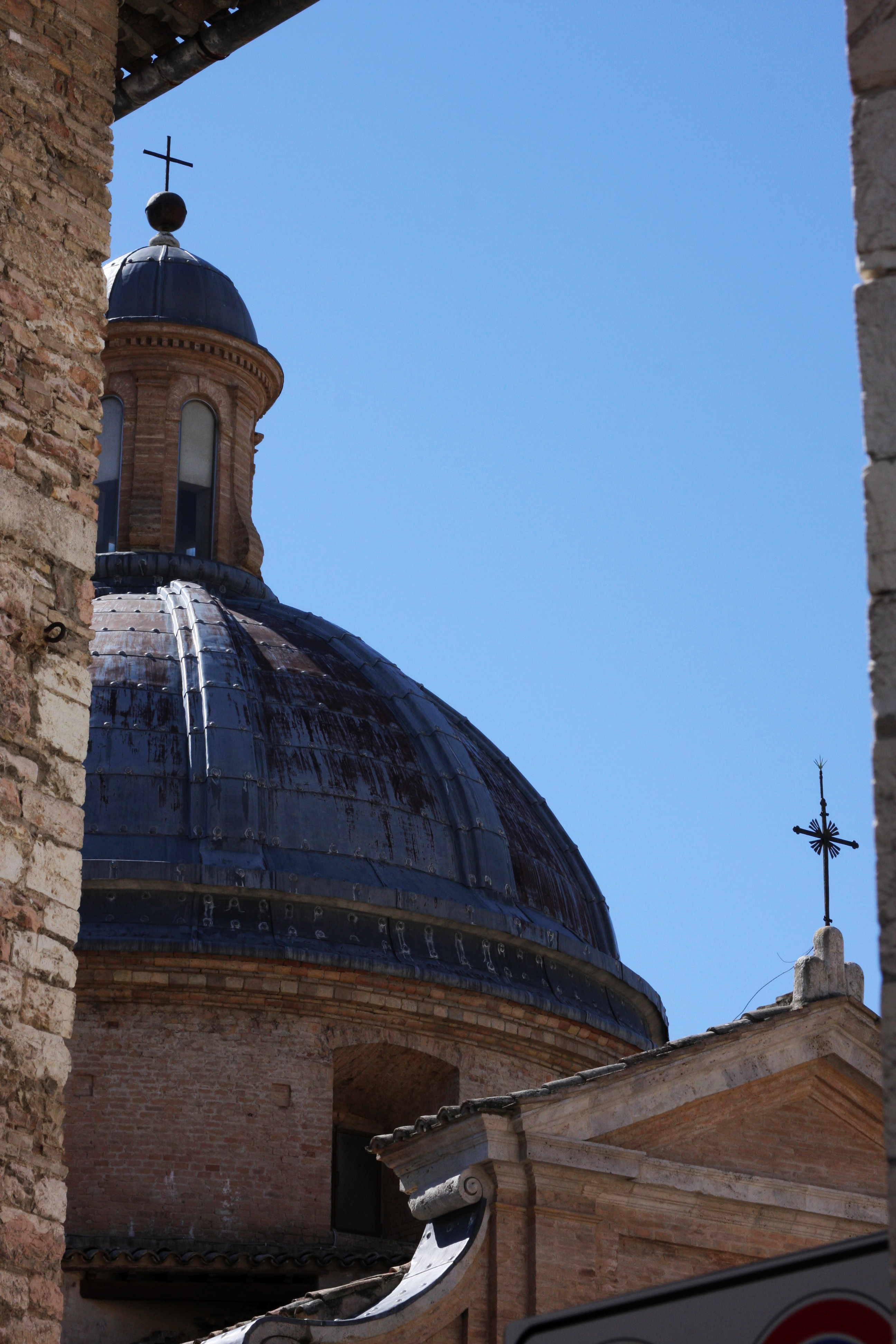
The word creche is from the French word for manger. The French word comes from the Italian word Greccio. Greccio was the town where the first manger scene was set up by St. Francis of Assisi in 1223, some say as an alternative for pilgrims wanting to go to Bethlehem, which was then occupied by the Turks. Before that time, many churches had built nativity scenes, but these early mangers were covered with gold, silver, and jewels. They were much fancier than the original manger in which the Christ child was laid. I was in Assisi last year. The house Francis was born in is now a large church (see photo at right.)
St. Francis wanted people to remember that Jesus was born in a humble stable. He asked a farmer friend of his to help by bringing an ox, a donkey, a manger and some straw to a nearby cave. On Christmas Eve, St. Francis and the people of Greccio met in this cave. By candlelight, they acted out the story of Jesus’ birth.
Bill Petro, your friendly neighborhood historian
www.billpetro.com
 HISTORY OF HEROD THE KING
When the wise men asked Herod the King “Where is he who is born king of the Jews?” their question was not really spoken in a vacuum, for even the Roman author Suetonius wrote, “There had spread all over the East an old and established belief that it was fated for men coming from Judea at that time to rule the world”. But as wise as they were, their inquiry before the King showed no great tact. For instead of understanding the question to mean “Where is he who will someday succeed you?” Herod’s suspicious mind warped the query into “Where is the REAL king, you impostor?” At the time Herod mistrusted everyone and thought himself surrounded by young aspirants all plotting to seize his throne.
Rather than clap the Magi in irons for asking such a question, his native shrewdness tried to ferret out whatever information he could from them in order to kill off a possible rival. From the information he had gained about the date of the appearance of the star, and from the Old Testament prophesies his own scholars knew of, Herod concluded that the “king of the Jews” was about 2 years old and living in Bethlehem. By the way, since Herod died in 4 B.C., and Jesus was around 2, we might surmise that Jesus was born between 6-4 B.C. Furthermore, the wise men did not visit Jesus in the manger, contrary to the Hallmark Christmas cards, but some time later, perhaps as much as 2 years later, when he was living in a house (Matthew 2:11.)
The young Herod had been an exceptionally able ruler, governing Palestine as client-king on behalf of the Roman emperor Augustus. The House of Herod had the uncanny knack of being able to sniff the airs of Mediterranean politics and make the right choices. Herod’s father had given crucial help to Julius Caesar when he was down in Egypt, cut off from his supplies, and Caesar rewarded him handsomely for that. Herod himself shrewdly advised his friend Mark Antony to drop Cleopatra and make peace with Rome — advice he should have followed. And once Augustus emerged victorious from the civil wars, he was so impressed with young Herod that he allowed him to become one of his most trusted friends.
 Herod beautified Palestine during his 33 year reign. He erected palaces, fortresses (Masada, for example, pictured at right), temples, aqueducts, cities, and — his crowning achievement — the great new Temple in Jerusalem. He created the magnificent port of Caesarea in honor of Augustus and stimulated trade and commerce. He also patronized culture in cities far from Palestine and easily became the talk of the eastern Mediterranean. He even sponsored the Olympic games of 12 B.C.!
But he had little support in his own kingdom. As a half-Jew he seemed far too Romanizing for his subjects, whom he taxed heavily. Soon he was hated as a tyrant, even by his own family. Herod was so jealous of his favorite wife (he married ten wives) that on two occasions he ordered that she be killed if he failed to return from a critical mission. He finally killed her anyway, as well as her grandfather, her mother, his brother-in-law, and three of his sons, not to mention numerous subjects. In his advancing paranoia, he was continually writing to Rome for permission to execute one or two of his sons for treason. Finally even his patron and friend Augustus had to admit, “I’d rather be Herod’s pig than his son.” It was not only a play on the similar sounding Greek words for son and pig, but a wry reference to the fact that pork, at least, was not consumed by Jews.
Old and very ill from arteriosclerosis, Herod worried that no one would mourn his death — a justified concern. So he issued orders from his deathbed that leaders from all parts of Judea were to be locked inside the great hippodrome at Jericho. When Herod died, archers were to massacre these thousands in cold blood, so there would indeed be universal mourning associated with his death. Although the leaders were gathered, the order was never given. Not only did this plan fail, but so did his plan to kill “he who has been born king of the Jews.”
Bill Petro, your friendly neighborhood historian
www.billpetro.com
From Paul L. Maier’s In the Fullness of Time
 HISTORY OF THE CHRISTMAS STAR
The Star of Bethlehem has puzzled scholars for centuries. Some have skeptically dismissed the phenomenon as a myth, a mere literary device to call attention to the importance of the Nativity. Others have argued that the star was miraculously placed there to guide the Magi and is therefore beyond all natural explanation. Most authorities, however, take a middle course which looks for some historical explanation for the Christmas star, and several interesting theories have been offered.
The Greek term for star in the Gospel account, “aster,” can mean any luminous heavenly body, including a comet, meteor, nova, or planet (wandering star). The Chinese have more exact and more complete astronomical records than the Near East, particularly in their tabulations of comets and novae. In 1871, John Williams published his authoritative list of comets derived from Chinese annuals. Comet No. 52 on the Williams list appeared for some seventy days in March-April of 5 B.C. near the constellation Capricorn, and would have been visible in both the Far and Near East. As each night wore on, of course, the comet would seem to have moved westward across the southern sky. The time is also very appropriate. This could indeed have been the wise men’s astral marker. Comet No. 53 on the Williams list is a tailless comet, which could well have been a nova, as Williams admitted. No. 53 appeared in March-April of 4 B.C. — a year after its predecessor — in the area of the constellation Aquila, which was also visible all over the East. Was this, perhaps the star that reappeared to the Magi once Herod had directed them to Bethlehem in Matthew 2:9? Comets do not display all the characteristics described in the full Nativity story. A planet or planets seems more likely.
The astronomer Johannes Kepler noted in the early 17th century that every 805 years, the planets Jupiter and Saturn come into extraordinary repeated conjunction, with Mars joining the configuration a year later. Since Kepler, astronomers have computed that for ten months in 7 B.C., Jupiter and Saturn traveled very close to each other in the night sky, and in May, September, and December of that year, they were conjoined. Mars joined the configuration in February of 6 B.C. The astrological interpretation of such a conjunction would have told the Magi much, if, as seems probable, they shared the astrological lore of the area. Jupiter and Saturn met each other in Pisces, the Fishes.
In ancient astrology, the giant planet Jupiter was styled the “King’s Planet,” for it represented the highest god and ruler of the universe: Marduk to the Babylonians; Zeus to the Greeks; Jupiter to the Romans. The ringed planet Saturn was deemed the shield or defender of Palestine, while the constellation of Pisces, which was also associated with Syria and Palestine, represented epochal events and crises. So Jupiter encountering Saturn in the sign of the Fishes would have meant that a divine and cosmic ruler was to appear in Palestine at a culmination of history.
Meanwhile, new research on the star based on recently available astronomy software and historical research on Josephus‘ manuscripts is being conducted and collected at www.bethlehemstar.net.
Bill Petro, your friendly neighborhood historian
www.billpetro.com
Inspired by Paul L. Maier’s In the Fullness of Time
 HISTORY OF THE WISE MEN
You’re familiar with the song that begins “We Three Kings of Orient Are…” but it is inaccurate in at least three ways. We don’t know how many there were, but we know they weren’t kings. They did not originate in the Orient, meaning the Far East.
How could they have seen the star “in the East” and arrived in Jerusalem unless they began somewhere in the middle of the Mediterranean Sea, as it says in the Gospel of Matthew 2:2 “We saw his star in the east, and have come to worship him”. One easy explanation is to see it in the sense of “We saw his star when we were in the east and have come from the east to worship him”.
A number of traditions places their number at three, with the presumption of three gifts for three givers: gold, frankincense, and myrrh. But some earlier traditions make quite a caravan of their visit, setting their number as high as twelve.
The term Magi is usually translated wise men, astrologers, or magicians (the word “magic” comes from magi). “The East”, has been variously identified as any country from Arabia to Media and Persia, but usually no further east.
What we know about their origin suggests to Mesopotamian or Persian origins for the magi, who were known to be an old and powerful priestly caste among both the Medes and Persians. These priest-sages who were extremely well educated for their day, were specialists in a variety of disciplines, including medicine, religion, astronomy, astrology, divination, and magic, and their caste eventually spread across much of the East. As in any profession, there were both good and bad magi, depending on whether they did research in the sciences or practiced augury, necromancy, and magic. The Persian magi at least were credited with higher religious and intellectual attainments, while the Babylonian magi were sometimes deemed impostors. The safest conclusion is that the Magi of Christmas were Persian, for the term originated among the Medo-Persians, and early Syriac traditions give them Persian names.
 Primitive Christian art in the second-century Roman Catacombs of Pricilla, which I have visited, dresses them in Persian garments, and a majority of early church fathers interpret them as Persians.
The Church of the Nativity was built in the 4th century by Emperor Constantine‘s mother St. Helena upon the traditional site in Bethlehem where Jesus was born, and indeed it is the only major church in the Holy Land that survives intact from the early Christian period. In 614, the church had a narrow escape. A Sassanian army from Persia had invaded the Holy Land and proceeded to destroy all the churches. However, they desisted at Bethlehem because they recognized the images of their ancestors, the Magi, above the entrance to the Church of the Nativity in Persian headdress. This account makes sense by virtue of the fact that the Magi were traditionally represented in early Christian art as Zoroastrian priests
Bill Petro, your friendly neighborhood historian
www.billpetro.com
Inspired by Paul L. Maier’s In the Fullness of Time