History Articles
 HISTORY OF CHANUKAH
Chanukah is also spelled hanukkah, meaning “dedication.” It begins this year at sundown tonight, December 11 with the last candle being lit on Friday, December 18. This Jewish holiday traces its roots back more than 2,000 years. At that time the Jewish people were living under the oppressive government of the Syrian ruler Antiochus Epiphanes IV, (a rather ironic name — Epiphanes means “God made manifest”) who was a descendant of Seleucus, the general of Alexander the Great. During his rule he forbade the reading of the Scriptures, circumcision, Sabbath observance, and a number of other religious practices. In order to further promote the “hellenization” of Palestine, he set up in the Temple of Jerusalem an altar dedicated to the Roman god Jupiter where swine were offered in sacrifice. This “Abomination of Desolation” caused the Jews to rebel in what became known as the Maccabean Revolt, and under the leadership of Judas Maccabee (“the hammer”) the Syrians were overthrown, and the Temple had all signs of paganism removed. The statue to Jupiter was ground to dust. A feast was instituted on 25 Kislew, 165 B.C. for the purification of the Temple. The story goes that light of the Temple was relit with only enough pure oil to last one day, but miraculously lasted for eight days, until more could be found. The Festival of Lights is celebrated for eight days.
One of the most important Chanukah customs is to light colorful candles in a menorah or candelabrum with eight branches, one for each night of Chanukah and one prominent one that holds the candle to be used to light the others. On the first night, one candle is lit and each succeeding night another is added so that all eight are alight on the last night. Because the Chanukah story involved oil, foods fried in oil are traditional for the holiday. Potato pancakes appear to have come to us from Russia. There the Jews made “latkes” or pancakes from a great variety of ingredients, from cheese to buckwheat flour to noodles. Legend says that women behind the lines, during the Jews’ fight against the Syrians 2,000 years ago, made flat cakes for the warriors because they could be prepared quickly.
Bill Petro, your friendly neighborhood historian
www.billpetro.com
 HISTORY OF LUCIADAGEN
In Sweden, December 13 is Luciadagen, St. Lucia’s Day, or in English, St. Lucy. It is the beginning of their holiday season. The Lutheran Danes and Norwegians also celebrate this day. St. Lucia was a young woman who lived in first century Rome. She was a Christian who would not give up her faith to marry an unbeliever. She was tortured and killed by order of the Roman magistrate Paschasius, who ordered her to burn a sacrifice to the Emperor Diocletian‘s image. As the ultimate torture, her eyes were gouged out but she was miraculously still able to see and pictures of her depict her holding her eyes on a golden plate, as she remains the patron saint for the blind. Dante consequently mentions Lucia in the second Canto of his Divine Comedy.
Stories of her courage were brought to Sweden by missionaries where she became known as the Lucia Bride. Old people said the Lucia Bride would go out early in the morning to bring food and drink to the poor. She wore white robes and a crown of light. Lucy, like the Latin “lux” means light. Under the old calendar, her day was the shortest of the year.
The story is acted out in Swedish homes with the oldest daughter playing the Lucia Bride. Early in the morning on December 13, she brings her parents a tray of sweet saffron buns and some coffee. She wears a white gown and a crown of greens, often made of holly. Her sisters and brothers dress in white and follow her. The girls carry lit candles and the boys wear tall, pointed caps and are called “star boys.”
St. Lucia is also honored in Sicily where she was born, and is the patron saint of Syracuse and known as Santa Lucia. Christians there gather to celebrate her day with bonfires and torchlight parades.
Bill Petro, your friendly neighborhood historian
www.billpetro.com
 HISTORY OF THE CHRISTMAS TREE
It is generally believed that the first Christmas tree was of German origin dating from the time of St. Boniface, English missionary to Germany in the 8th century, who replaced the sacrifices to the Norse god Odin’s sacred oak by a fir tree adorned in tribute to the Christ child. The legend is told that Boniface found a group of “pagans” preparing to sacrifice a boy near an oak tree. He cut down the oak tree with a single stroke of his ax and stopped the sacrifice. A small fir tree sprang up in place of the oak. He told the pagans that this was the “tree of life” and stood for Christ.
In the early Middle Ages there began to circulate a legend that when Jesus was born in the dead of winter all the trees throughout the world shook off their ice and snow to produced new shoots of green.
 During Renaissance times there are records that trees were being used as symbols for Christians first in the Latvian capital of Riga in 1510. The story goes that it was attended by men wearing black hats in front of the House of Blackheads in the Town Hall Square, who following a ceremony burnt the tree. But whether it was for Christmas or Ash Wednesday is still debated. I’ve stood in that very square myself in the Winter, surrounded by snow.
 Accounts persist that Martin Luther introduced the tree lighted with candles in the mid 16th century in Wittenburg, Germany. He wrote often of Advent and Christmas. One of his students wrote of Luther saying:
For this is indeed the greatest gift, which far exceeds all else that God has created. Yet we believe so sluggishly, even though the angels proclaim and preach and sing, and their lovely song sums up the whole Christian faith, for “Glory to God in the highest” is the very heart of worship.
Returning to his home after a walk one winter night, the story goes, Luther tried unsuccessfully to describe to his family the beauty of the starry night. Instead, he went out and cut down a small fir tree and put lighted candles upon it.
In a manuscript dated 1605 a merchant in Strasbourg, Germany wrote that at Christmas, they set up fir trees in the parlors in Strasbourg and “hang thereon roses cut out of paper of many colors, apples, wafers, spangle-gold and sugar…” Though the selling of Christmas trees are mentioned back to the mid 1500s in Strasbourg, the custom of decorating the trees may have developed from the medieval Paradise Play. This play was a favorite during the Advent season because it ended with the promise of a Savior. The action in the play centered around a fir tree hung with apples.
 The earliest date in England for a Christmas Tree was at Queen’s Lodge, Windsor by Queen Charlotte, the German born wife of George III, for a party she held on Christmas Day, 1800, for the children of the leading families in Windsor. Her biographer Dr John Watkins describes the scene:
In the middle of the room stood an immense tub with a yew tree placed in it, from the branches of which hung bunches of sweetmeats, almonds, and raisins in papers, fruits and toys, most tastefully arranged, and the whole illuminated by small wax candles. After the company had walked around and admired the tree, each child obtained a portion of the sweets which it bore together with a toy and then all returned home, quite delighted.
 The Christmas Tree was most popularized in England, however, by the German Prince Albert, soon after his marriage to Queen Victoria. In 1841, he began the custom of decorating a large tree in Windsor Castle. In 1848, a print showing the Royal couple with their children was published in the “Illustrated London News.” Albert gave trees to Army barracks and imitation followed. From this time onwards, the popularity of decorated fir trees spread beyond Royal circles and throughout society. Even Charles Dickens referred to the Christmas tree as that ‘new German toy.’ German immigrants brought the custom to the United States and tree decorating is recorded back to 1747 in Bethlehem, Pennsylvania.
Many individuals and communities vie for the honor of having decorated the first Christmas tree in America. One interesting story tells of Hessian soldiers who fought for George III in the Revolutionary War. As they were keeping Christmas in Trenton, New Jersey around a decorated tree, they left their posts unguarded. George Washington and his troops were hungry and freezing at Valley Forge, but they planned their attack with the knowledge that the Hessians would be celebrating and thus would not be as able to defend themselves.
Christmas trees really became quite popular in the United States following the invention of the electric light. In 1895, President Grover Cleveland decorated the tree at the White House with electric Lights. This idea caught on and spread across the country.
Bill Petro, your friendly neighborhood historian
www.billpetro.com
 HISTORY OF A CHRISTMAS CAROL
The Christmas season in 1843 saw the publication of Charles Dickens’ “A Christmas Carol.” No other book or story by Dickens or anyone else (except the Bible) has been more enjoyed, criticized, referred to, or more frequently adapted to other media. One of my favorites was watching Patrick Stewart doing his one-man version of the play at the Old Vic Theatre in London. None of Dickens’ other works is more widely recognized or celebrated within the English-speaking world. Some scholars have even claimed that in publishing A Christmas Carol, Dickens single-handedly invented the modern form of the Christmas holiday in England and the United States.
Indeed, the great British thinker G.K. Chesterton noted long ago, with “A Christmas Carol” Dickens succeeded in transforming Christmas from a sacred festival into a family feast. In so doing, he brought the holiday inside the home and thus made it accessible to ordinary people, who were now able to participate directly in the celebration rather than merely witnessing its performance in church.
 Many of our American conceptions of what a “traditional” Christmas is, comes from this time in Victorian history. Indeed, Queen Victoria of England had just married a few years before the publication of this book. Her German husband Prince Albert brought some of his native customs to England (including the Christmas tree), beginning some of the traditions of Victorian Christmas.
In the mid-seventeenth century, the Cromwellian Revolt abolished the celebration of Christmas as well as the monarchy. Though the monarchy was subsequently “restored,” the traditions of the winter holiday never quite recovered. But the earlier religious proscription was not the only cause of the decline of Christmas. Even by the beginning of the nineteenth century, the Industrial Revolution, especially in the north, was changing the communities that still tenuously kept the customs of their ancestors.
 By the time the Carol was written in 1843, the lavish celebrations of the past were a distant, quaint memory. Some still remembered them, and even before the Carol a few popular books attempted to record the celebrations of the past, such as The Book of Christmas by T.H. Hervey (1837) and The Keeping of Christmas at Bracebridge Hall by Washington Irving (1820). But social forces beyond simple nostalgia were at work, rekindling the need for winter celebrations.
Dickens was one of the first to show his readers a new way of celebrating the old holiday in their modern lives. His Christmas celebrations of the Carol adapted the twelve-day manorial (Yule) feast to a one-day party any family could hold in their own urban home. Instead of gathering together an entire village, Dickens showed his readers the celebration of Fred, Scrooge’s nephew, with his immediate family and close friends, and also the Cratchit’s “nuclear family”: perfectly happy alone, without the presence of friends or wider family. He showed the urban, industrial English that they could still celebrate Christmas, even though the old manorial twelve-day celebrations were out of their reach. Dickens’ version of the holiday evoked the childhood memories of people who had moved to the cities as adults.
 The book has been called by some a “sledge hammer” against the ills of industrialism and consumerism. Dickens’ own father had been sent to Debtors’ Prison and Charles Dickens himself bitterly remembered having to leave school, pawn his books, and work in a factory during that time. He’d seen children working long hours in the tin mines and attending poor schools. He modeled the Cratchit’s lifestyle on his own experience in Camden Town, London. Dickens demonstrates that even in poverty, the winter holiday can inspire good will and generosity toward one’s neighbors. He shows that the spirit of Christmas was not lost in the race to industrialize, but can live on in our modern world.
The publishing of his book was immensely popular, though in a time of great religious controversy, and its lack of babes, wise men, stars, mangers, and other icons of the Christian nativity inspired a multitude of sermons and pamphlets at that time. Although A Christmas Carol is generally associated with the Christian winter holiday season, for it does contain references to Christ “who made lame beggars walk and blind men see.” And so, at the end of the story, we see both lame and blind touched by the Spirit of Christmas. Nevertheless, its themes are not exclusive to Christianity and it inspired a tradition for decades in Christmas books and celebrations that appealed to many non-Christians.
Dickens’ preface to the book reads:
I have endeavoured in this Ghostly little book, to raise the Ghost of an Idea, which shall not put my readers out of humour with themselves, with each other, with the season, or with me. May it haunt their houses pleasantly, and no one wish to lay it.
Their faithful Friend and Servant, C.D., December, 1843.
But the punch line to the book, is the very last sentence, which rarely fails to bring a tear to this historian:
It was always said of Scrooge, that he knew how to keep Christmas well, if any man alive possessed the knowledge. May that be truly said of us, and all of us! And so, as Tiny Tim observed,
God Bless Us, Every One!
Bill Petro, your friendly neighborhood historian
www.billpetro.com
excerpts from Prof. Gerhard Rempel, Lectures in Western Civilization
 HISTORY OF CHRISTMAS TRADITIONS
Many of the customs that we associate with Christmas come from largely pagan or pre-Christian backgrounds.
- The word Yule comes from an old Norse word for a twelve-day celebration.
- Mistletoe was prominent in the traditions of the Druids and the lore of northern Europe.
- The wassail bowl was first known in Scandinavia.
- Holly was used for decoration in the twelve-day Roman holiday known as the Saturnalia, which was followed by twelve holy days ending on January 1, and is where we get the “Twelve Days of Christmas.”
Contrary to popular belief, the “X” in Xmas is not an abbreviation for “cross.” It represents the Greek letter chi which looks like our letter “X” and is the first letter in the Greek word Χριστός (christos) which like the Hebrew word מָשִׁיחַ (messiah) means “the anointed one.”
Bill Petro, your friendly neighborhood historian
www.billpetro.com
 HISTORY OF SANTA CLAUS
December 6 is “Saint Nicholas Day.” Santa Claus, a contraction for Saint Nicholas, was born in the 3rd century, perhaps in A.D. 270. He became a bishop in Greece and gained distinction in the councils of the church, being especially famed for unexpected gifts, and later associated with the giving of presents during the season at the end of the year. “I am Nicholas, a sinner,” the old saint would say, “Nicholas, servant of Christ Jesus.” He was imprisoned during the great persecutions under the Roman Emperor Diocletian in A.D. 303 but freed by decree of Emperor Constantine. Thereafter, he served as Bishop in Myra for another thirty years. Nicholas participated in the famous Council of Nicaea in 325. He died on December 6, about 343, and the Feast of St. Nicholas is now held on that day.
Many stories are told of his kindness, such as the one of the poor man and his three daughters. To save the daughters from being sold into prostitution for want of dowries, St. Nicholas dropped a bag full of gold down the man’s chimney. It landed in one of the stockings the eldest daughter had hung up to dry. Now she could be married. The other two daughters quickly hung up stockings for St. Nicholas to fill with gold, so that they, too, could soon be married. By the way, the three gold globes of the pawn shop are attributed to this story.
He seems to have been adopted by the Netherlands as the patron saint of children, and there, on St. Nicholas Eve, they leave their wooden shoes, or sabots, filled with hay for the Saint’s white horse. He is real to children the world over, under various names as Kris Kringle, La Befana, Yule Tomten, and Christkindli.
In 1809 Washington Irving, under the pen name Diedrich Knickerbocker, wrote “A History of New York,” wherein Saint Nicholas, a jolly personage smoking a Dutch pipe, skimmed over the treetops in a wagon and dropped presents down the chimneys.
 A few years later, in 1822, Clement C. Moore reputedly wrote a poem for his own children which is most often called “The Night Before Christmas.” However, Don Foster in his book “Author Unknown,” makes a case that Henry Livingston actually penned it in 1807 or 1808. But whatever the case, the correct title of the poem is “A Visit from St. Nicholas.” Many are unaware that never once in the poem was used the term Santa Claus, although the reindeer are there, a part of the legend undoubtedly developed in America, probably by Scandinavians in the United States.
During the Christmas season of 1862, Thomas Nast, the cartoonist, drew a picture of Santa Claus for Harper’s Weekly at the time of the Civil War. Nast combined his own native German traditions of Saint Nicholas with other German folk traditions of elves in creating the image, seen at right. His various pictures of Santa Claus ran through 1866, firmly cementing the image in the American mind. The name Santa Claus also became more familiar to American ears than the German Sankt Niklaus or Dutch Sinterklaas.
Finally, in the 1930s that the now-familiar American Santa image solidified. The artist Haddon Sundblom began Coca-Cola Santa advertisements running for thirty-five years which finally established Santa as an icon of contemporary commercial culture. This Santa was not an elf, but a man — jolly, and wearing the now familiar white fir-trimmed red suit.
Bill Petro, your friendly neighborhood historian
www.billpetro.com
 HISTORY OF CHRISTMAS MUSIC
Music early became a marked feature of the Christmas season. But the first chants, litanies, and hymns were in Latin and too theological for popular use. The 13th century found the rise of the carol written in the vernacular under the influence of Francis of Assisi. The word carol comes from the Greek word choraulein. A choraulein was an ancient circle dance performed to flute music. In the Middle Ages, the English combined circle dances with singing and called them carols. Later, the word carol came to mean a song in which a religious topic is treated in a style that is familiar or festive. From Italy, it passed to France and Germany, and later to England, everywhere retaining its simplicity, fervor, and mirthfulness. Music in itself has become one of the greatest tributes to Christmas, and includes some of the noblest compositions of the great musicians.
Interestingly enough, during the British Commonwealth government under Oliver Cromwell, the British Parliament prohibited the practice of singing Christmas carols as pagan and sinful. Its pagan roots in the 13th century and its overly “democratic” 14th century influences made it an unsuitable activity for the general public and it was to be mandated so, by the Commonwealth government of 1647. Puritans at this time disapproved as well of the celebration of Christmas, and did not close shop on that day, but continued to work through December 25. This was true too in New England in America, where in Boston one could be fined five shillings for demonstrating Christmas spirit. During this brief interlude in English history, during which there was no monarch, this activity by the populace was to remain illegal. But this activity was prohibited only as long as the Commonwealth survived, and in 1660, when King Charles II restored the Stuarts to the throne, the public was once again able to practice the singing of Christmas carols.
No musical work is more closely associated with the Christmas season than “Messiah” by George Frederick Handel (1685-1759). It may come as something of a surprise that it had nothing to do with the Christmas season when it was composed. It was initially performed for Lent, but since Handel’s death is usually performed during Advent. Incidentally, the full title of the work is merely “Messiah” although it is widely but inaccurately referred to as “The Messiah”. The composer was German by birth but became a naturalized Englishman in 1726. He wrote “Messiah” in the summer of 1741 in his characteristically quick 24 days, and his first performance was the following spring in Dublin.
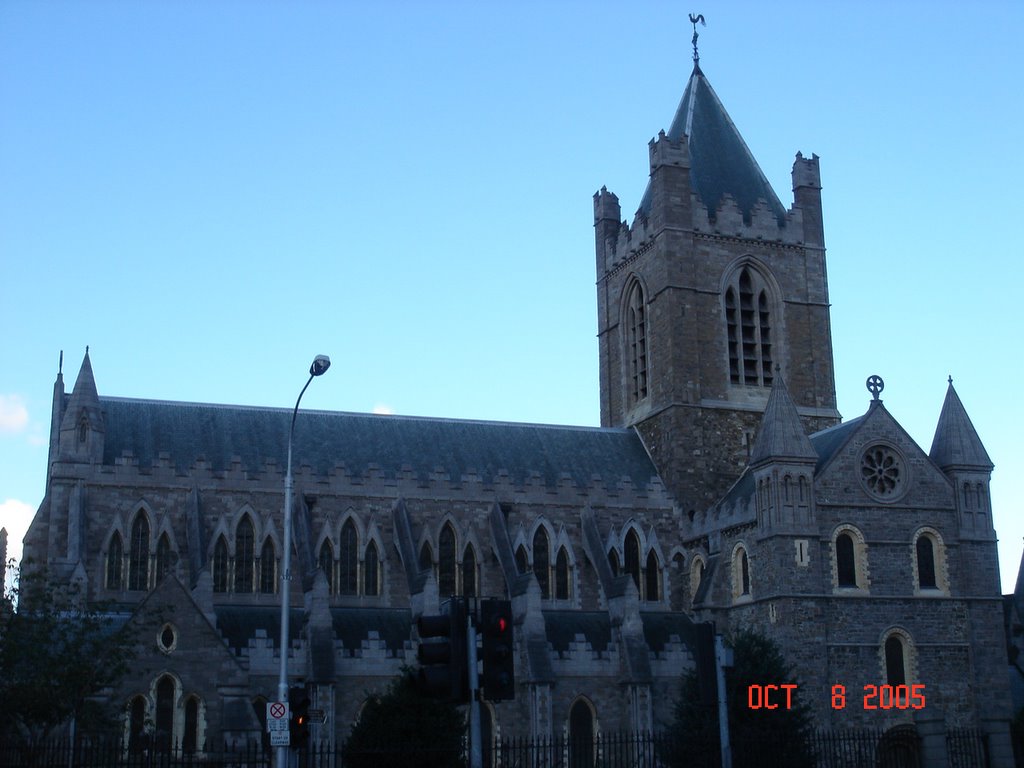
 “Messiah” is usually attributed to have been originally done at Christ Church Cathedral, but that is only half true. While the Christ Church choir performed it, along with the choir from St. Patrick’s Cathedral located three blocks away, (pictured at right) the actual performance was done at Neal’s Music Hall on Fishamble Street half a block away from Christ Church on April 13 (pictured below.) For a while, Handel lived about a mile away, north and across the River Liffey. The music hall no longer exists, but the plaque below commemorates its location. The premiere was a benefit for prisoners in jail for debt as well as for a hospital and an infirmary. Enough money was raised to free 142 unfortunate debtors. It premiered in London a year later, but under the name “A Sacred Oratorio.”

Bill Petro, your friendly neighborhood historian
www.billpetro.com
 HISTORY OF A SACRED ORATORIO
The genteel reception accorded the original debut performance stood in marked contrast to the savage hostility which greeted the work less than a year later in London. The English aristocracy and churchmen began an unrelenting campaign against the work and its creator. They labeled it “a profanation,” scandalized at “the sacrilege of converting the Life and Passion of Christ into a theatrical entertainment.” Some clergymen objected so strongly to the idea of printing the actual title on the program that the author was obliged to announce his great work as “A Sacred Oratorio.”
The city of London was hit on the one hand by fierce propaganda against the work, wherein the Oratorio was denounced as unsuitable and sacrilegious, and on the other hand by those – who never bothered to attend any performances – calling the author “an insufferable German upstart” and “a dissolute fellow.” This was the man who Haydn, on hearing the chorus, later said, “He is the master of us all” and of whom Beethoven, when asked who was the greatest composer said, “to him I bow the knee.” Yes, the London debut was quite different from the enthusiastic reception that Handel got a year earlier in Dublin when he first performed the sacred oratorio “Messiah.”
Indeed, when Handel’s Messiah premiered in Dublin in 1742 by the choirs of St. Patrick Cathedral and Christ Church Cathedral (pictured above,) the demand for tickets was so great that the newspapers made an unusual request. Editors asked that ladies who planned to attend refrain from wearing hoop skirts and that gentlemen leave their swords at home. This would free up more space and allow more people to be seated.
Bill Petro, your friendly neighborhood historian
www.billpetro.com
With thanks to Paul Harvey’s “The Rest of the Story”
 HISTORY OF CHRISTMAS: THE YEAR
It’s obvious that Jesus was born on December 25, A.D. 1 , right? Wrong. What we do know is that Herod the Great (who killed all the babies in Bethlehem younger than 2 years of age) died in the Spring of 4 B.C. according to the Jewish historian Josephus, and the king was quite alive during the visit of the Wise Men (Magi) in the Nativity story told in the Gospel of Matthew. So Jesus would have to have been born before this time, anywhere from 7 B.C to 4 B.C. (Before Christ, or before himself!)
Why is there a gap of this much time in our modern calendar? We owe this to a Roman monk-mathematician-astronomer named Dionysis Exeguus, known to his friends as Dennis the Little. During the 6th century A.D. he unwittingly committed what has become history’s greatest numerical error as it relates to the calendar. As he endeavored to reform the Western calendar to center around Jesus’ birth, he erroneously placed the date of the Nativity in the year 753 “from the founding of Rome” (753 a.u.c. or Ab Urbe Condita), even though Herod died only 749 years after the founding of the city of Rome. The cumulative effect of Dionysis’ calendar error, which is the same calendar we use today, was to give the correct traditional date for the founding of Rome, but one that is at least 4 to 7 years off for the birth of Christ.
Did you celebrate the Y2K change of Millennium in 1997?
Bill Petro, your friendly neighborhood historian
www.billpetro.com
 NATIVITY SEASON
Greeting cards depict Joseph along with Mary on the back of a donkey making their way to Bethlehem in the wintry snow. But could Jesus have been born during that time of the year, perhaps with snow on the ground? While it is uncommon it does snow in this part of Palestine sometimes as much as three to four days a year. At an elevation of 2,400 feet Bethlehem is in the desert. But desert means dry, not hot. Where I live in Colorado is officially the high desert, and we have snow all the time! In January of 2002 there were several inches of snow across parts of Palestine. Bethlehem got another snow fall in February of 2004, But the Biblical narrative doesn’t say there was snow on the ground.
It says “…shepherds watched their flocks by night…” It is usually pointed out that shepherds don’t have sheep on the hillsides during the winter. But there were flocks of a special kind of sheep, those designated for sacrifice at the Temple in Jerusalem who were kept all year round near Bethlehem at Beit Sahur, the “Place of the Night Watch.” A more precise location is given in Micah 4:8 as Migdal Edar, or the “Tower of the Flock.”
In point of fact, as mentioned in our previous article, we don’t know with certainty what time of the year the Nativity occurred. Two millennia ago it was rare indeed to track the specific date of birth. Neither the gospel of Matthew nor Luke mention either a specific year, nor time of year. Matthew ties it to King Herod, who we know died in 4 B.C., while Luke associates it with the census of Emperor Augustus when Publius Sulpicius Quirinius was governor of Syria, around the same time.
While we have documentation that Christmas was celebrated on December 25th as early as A.D. 330 in the Western Church, the Eastern Church celebrated their holiday on January 6th, known as Epiphany (or Theophany) with the visit of the Wise Men. We’ll look at the History of Epiphany in January.
Bill Petro, your friendly neighborhood historian
www.billpetro.com
 THE HISTORY OF CHRISTMAS: ADVENT
Here begins our series of articles on the History of Christmas.
The Advent Season — Advent means the “coming” of the Christ Child — is marked by the four Sundays before Christmas and is celebrated in the church calendar as one the most festive seasons of the year.
As we shall see, many of the traditions, customs, and stories of the Advent Season have Christian roots while others have non-Christian sources. Some are legendary, and others are firmly rooted in history.
It is perhaps ironic that the actual date for the Nativity or birth of the Christ Child, which our Western calendar system is based upon, is not known with certainty. Indeed, the Feast of Christmas was not an early festival for the church, like Resurrection Sunday (Easter) was, and in fact did not see general observance until the 4th century. The western church did not agree upon the current date of December 25 until the early part of the 5th century under Pope Leo I, though this date for Christmas was first mentioned in the 4th century illuminated manuscript the Chronography of 354. Some historians suggested that the date of Christmas was derived as 9 months after the Annunciation (to Mary) which is celebrated on March 25. Many 18th century scholars, including Isaac Newton, argued that this date was picked to supplant the pagan year-end holiday Saturnalia that was celebrated by the Romans and many of whose customs survive today: decorations of evergreen, holly, mistletoe, feasting and the exchange of gifts.
December 25, the ancient date for their Winter Solstice, was celebrated as the birthday of the “unconquerable sun” or dies natalis solis invicti when the sun’s transit was in the lowest point on the horizon with the shortest “day” of the year and then with longer days coming began its transit northward. Under the Christian calendar the 25th was to become known as the birth of the unconquerable Son.
Bill Petro, your friendly neighborhood historian
www.billpetro.com
 History of General Winn: The Passing of a Hero
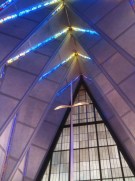
At the Air Force Academy Chapel, I attended the memorial service for Brigadier General David W. Winn, whose family I have known for a decade and more. It was a moving experience to participate in a service with full military honors, befitting an officer of such singular character, having earned the Silver Star and Distinguished Flying Cross, a man whose life was so well lived.
This is a man who has fought for his country in two wars, first joining up at 19 and flying 54 combat missions in B-26 bombers in the Mediterranean Theater during World War II. Following the war, he attended college before returning to active duty.
During the Cold War, he served in the 109th Fighter Squadron, in Germany with the 86th Fighter, and subsequently with the Air Defense Command