History of Halloween: The Sacred and the Secular

Halloween Jack-o’-lantern. Image: Wikipedia

HISTORY OF HALLOWEEN
Halloween (All Hallows’ Eve) is the evening of October 31. In its strictly religious sense, this occasion is known as the vigil of Hallowmas, or All Saints’ Day (November 1), observed by the Roman Catholic and Anglican churches.
In the fourth decade of the 8th century, Pope Gregory III is traditionally credited with moving this holiday to its present date (from May 13) to celebrate the dedication of an oratory in St. Peter’s Basilica in Rome to all the saints.
Pope Gregory IV extended the feast for the entire church in 835. In Latin European countries, people mainly observe the evening of October 31 as a religious occasion.
In the late 10th or early 11th century, Odilo of Cluny popularized All Souls’ Day, forming the three-day triduum of Allhallowtide. The term Allhallowtide comes from Old English eall (‘all’), hālga (‘holy one,’ ‘saint’), and tīd (‘time,’ ‘season’).
The three days of Allhallowtide are:
- October 31: Halloween – All Hallows’ Eve or All Saints’ Eve
- November 1: All Saints’ Day – commemorates all the saints (‘hallows’) in Heaven, including martyrs (from the Greek martys, ‘witness’) who died for their faith
- November 2: All Souls’ Day – a day of prayer — especially in the Roman Catholic Church — for the souls of believers in Purgatory, who await having their souls purged of sin
Popularity of Halloween
In Great Britain, Ireland, and the United States, ancient Halloween folk customs persist alongside the religious observance. Halloween is the second most popular holiday in the U.S. after Christmas, at least according to retailers, with overall Halloween spending predicted to exceed $13.5B, and ranks first in candy sales alone at $4.1B.
Halloween Trivia:
Maryland spends more on Halloween candy per resident than any other state ($67.95)
Costume sales of $4.4B and decoration sales of $4.3B each outspend candy. More and more, houses are being decorated with “Halloween lights.” Parties are popular and increasingly take place on the weekend before Halloween.
Indeed, Halloween lasts for at least two months or longer in the U.S. and starts earlier every year:
- Usually, decorations go on sale at most retailers in August, after back-to-school displays come down
- But Costco rolls out Halloween costumes and decorations in late June to mid-July… 4 months before Halloween
- Candy shopping begins in mid-September; popular brands sell out before Halloween
- My neighbor had his Halloween decorations up in September
Unique Halloween Celebrations
- Salem, MA, is a popular destination for Halloween celebrations, with its month-long Haunted Happenings celebrations, tied to the Salem Witch Trials of 1692. When I traveled to Boston for work, Massachusetts Turnpike traffic signs note that Salem is reachable from Boston via Route 1A North.
- In Tokyo, I’ve seen young people dress in Western-style costumes for Halloween, especially in the Harajuku district along Takeshita Street. In recent years, the ward has discouraged gatherings, and Shibuya has become a more popular alternative.
Ancient Rome

Pomona. Image: Francis Helminski / Wikipedia
Some older folklorists, in the 18th and 19th centuries, claimed that popular Halloween customs show traces of the Roman harvest festival of Pomona and Celtic Druidism. These influences are inferred from the use of nuts and apples as traditional Halloween foods. Medieval motifs of witches, black cats, and skeletons were commonly associated with the occasion.
In Rome, Pomona was a goddess of flourishing fruit trees, gardens, and orchards (from the Latin word pomum, “fruit,” specifically orchard fruit), but she was not part of the major pantheon of Roman gods and goddesses (and had no Greek counterpart).
In his Metamorphoses, Ovid says she scorned the woodland god Silvanus, and instead Vertumnus won her love; they shared a festival on August 13.
Pre-Christian Europe
In pre-Christian Ireland and Scotland, the Celtic year ended on October 31, the eve of Samhain, and was celebrated with both religious and harvest rites. For the Druids, Samhain (pronounced: SOWin) was long believed to mark both the “end of summer” and a festival of the dead. As winter approached, people believed the spirits of the departed visited their relatives in search of warmth and good cheer. People also believed it was an occasion when fairies, witches, and goblins terrified the populace.
The agents of the supernatural were alleged to steal infants, destroy crops, and kill farm animals. People lit bonfires on hilltops on Samhain eve. They may have lit the fires to guide the spirits of the dead to their relatives’ homes… or to ward off witches. In some regions of Scotland, people called Halloween Nutcrack Night.
Jack-o’-lanterns originated in Ireland and Britain with turnips and mangelwurzels, but Americans popularized them with pumpkins. A folktale says Stingy Jack tried to trick the devil. After his death, he was cursed to wander the earth with a burning coal lighting a hollowed turnip. He was called Jack of the Lantern, or Jack O’Lantern.
- In the city centre of modern-day Dublin, signs advertise “Samhain Halloween” parties. Samhain is also the name for November in modern Scottish Gaelic.
Medieval Europe
In the late Middle Ages and early modern period, the common folk believed witches worshipped Satan at periodic gatherings called Witches’ Sabbaths, which were allegedly given over to feasting and revelry. One of these Sabbaths was held on Halloween. Witches were said to fly to these meetings on broomsticks, accompanied by black cats, their constant companions. Stories about these Sabbaths are the source of much Halloween folklore.
Shakespeare and Witches

Macbeth and Banquo encounter the Three Witches. Image: Wikipedia

“Double, double toil and trouble;
Fire burn and cauldron bubble…”
You might be able to recite this eerie couplet from memory without realizing it came from the Bard. It appears in his play Macbeth, Act IV, as part of the “Song of the Witches.” Beyond these spooky lines, this section contributes significantly to our modern interpretation of witches.
Three witches give the Scottish prince Macbeth a shocking prophecy: He will become king of Scotland.
The 1606 play was published around the height of Scotland’s witch trials, which had been going on since the 15th and 16th centuries in parts of Early Modern Europe, and in the later 17th century in the American Colonies.
So it makes sense that Macbeth’s downfall was initiated by a chance encounter with three “Weyward Sisters.” Many editions call them “Weird Sisters,” but “weird” doesn’t mean what it does today as a synonym for “odd” or “quirky.” Instead, “weird” means “supernatural” or “otherworldly.”
Shakespeare transformed the imagery of witches through his depiction in Macbeth. His witchy imagery is far-reaching. Their physical appearance is chilling and sinister, with deep wrinkles of the “chappy finger.” Consider:
“By the pricking of my thumbs
Something wicked this way comes…”
Said by the second witch in Macbeth, this famous phrase refers to the old-fashioned superstition of tucking the thumb into the palm to protect against supernatural entities.
Like so many Shakespearean lines, it has become a stand-alone expression. Author Ray Bradbury borrowed part of it for the title of his 1962 dark fantasy novel (and later, the 1983 film), Something Wicked This Way Comes.
Colonial America Halloween
In 17th-century Puritan New England, Puritans shunned Halloween, along with Christmas (which Massachusetts outlawed from 1659 to 1681) and Easter – though Catholic Maryland and Anglican Virginia retained some Halloween customs.
19th Century Halloween
During 19th-century Victorian times, Halloween was generally tame and devoid of occult overtones. Instead of pulling pranks or haunting neighborhoods, young people chatted and flirted in parlors decorated with festive decorations.
In mid-19th-century Ireland and Scotland, young people imitated malevolent spirits and played pranks on neighbors at this time of year. Samhain became nicknamed “Mischief Night.” After 1845, immigrants fleeing the Irish Potato Famine brought this tradition to the U.S., and Halloween became a night of mischief. Halloween became almost a civic affair with block parties and parades. But pranks and mischief were common. Wandering groups of rural celebrants blocked house doors with carts, carried away gates and plows, tapped on windows, threw vegetables at doors, and covered chimneys with turf so smoke could not escape.
20th Century Halloween

Beistle Company Halloween decorations. Image: Beistle Company
In 1921, the Beistle Company introduced a line of Halloween-themed decorations. Martin Luther Beistle, who wanted to create artificial lobby plants, was inspired by a visit to Heidelberg, Germany, to use honeycombed tissue paper for decorations and other products. People draped paper cats, skeletons, and witches around their homes.
Partygoers danced and sang to tunes like Helen Gross & the Kansas City Five‘s “Undertaker’s Blues,” Louis Armstrong‘s “Heebie Jeebies,” and “The Nightmare” by The New Orleans Owls… decades before Bobby “Boris” Pickett‘s “Monster Mash.”

1922 bobbing for apples. Image: Topical Press Agency/Getty Images
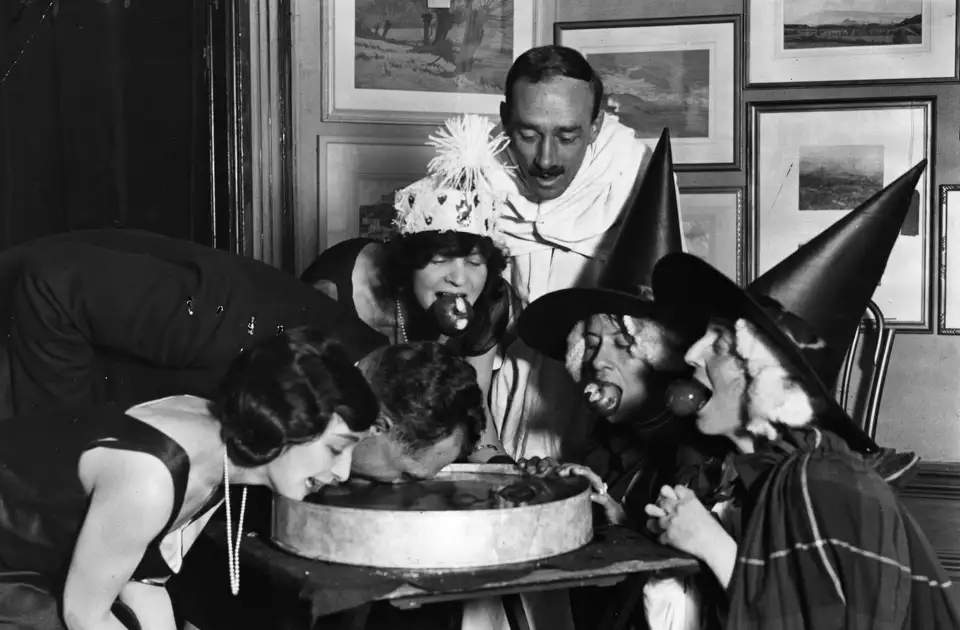
A classic matchmaking game was dunking, or “bobbing for apples.” In the 1920s, it was said that if a man caught an apple labeled by a woman, they were destined to be together.
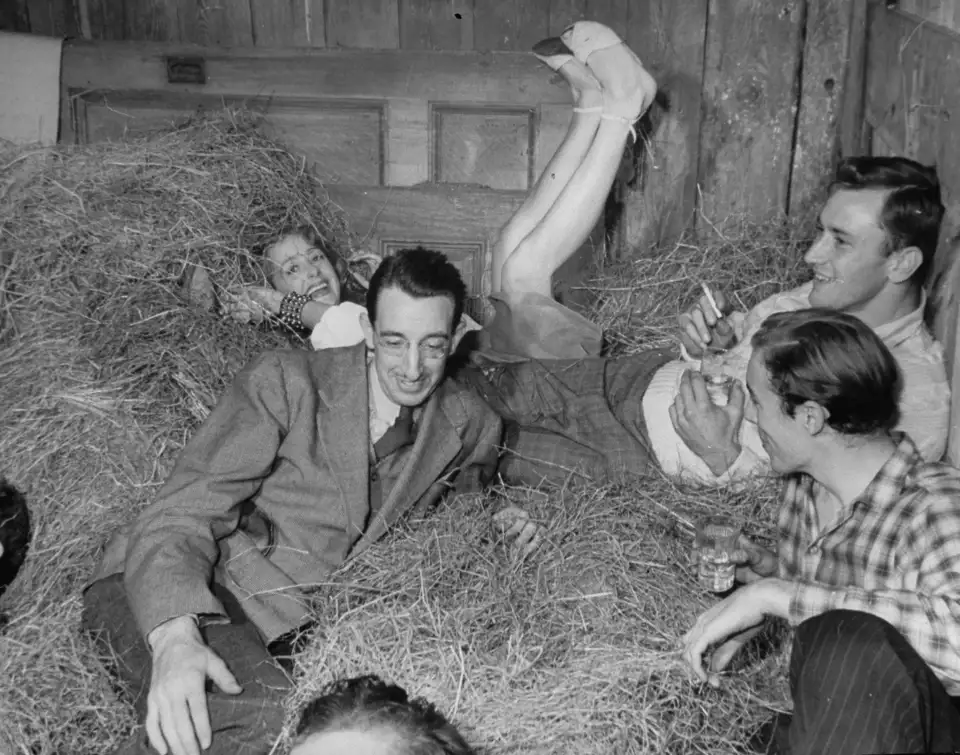
During Prohibition (1920–1933), Halloween was more trick than treat; guests at Doris Dudley’s 1932 party lived dangerously, smoking in the hayloft.

Guests at Doris Dudley’s Halloween party, 1932. Image: John Phillips / The LIFE Picture Collection / Getty Images
Pranks were a part of the holiday. Mischievous children and teens would steal property, pelt people with sacks of flour, and hoist odd objects on neighbors’ roofs, all while wearing Halloween masks. The vandalism got so out of hand that some municipalities considered canceling Halloween events altogether in the late 1920s and into the 1930s.
The phrase “trick-or-treat” – long before the modern “trunk-or-treat” trend – dates back about a century, when kids would arrive at doorsteps in costumes and perform a trick – a song, poem, or joke – to earn a treat. Unlike today, children didn’t just expect candy; they had to be a little creative to fill their bags. The holiday wasn’t safely “domesticated” as it is today, with street parties, parades, candy as the primary exchange, and church-supervised trunk-or-treat until after World War II.
Modern Practices of Halloween

Curtis Halloween Trick-or-Treat candy with a full-sized candy bar, not the “fun size.” Source

Following World War II and the end of sugar rationing in 1947, candy became more readily available.
In some places, boys and girls dressed in the opposite sex’s clothing and, wearing masks, visited neighbors to play tricks. These activities generally resembled the harmful and mischievous behavior attributed to witches, fairies, and goblins.
Trick or Treat from the British Isles
The modern “trick or treat” custom resembles an ancient Irish practice tied to Allhallows Eve. Groups of peasants went from house to house, demanding food and other gifts to prepare for the evening’s festivities. Prosperity was assured for liberal donors, and threats were made against stingy ones.
People in Cork, Ireland, in the 19th and early 20th century often demanded these contributions in the name of Muck Olla, a figure of folklore sometimes claimed as a Druid deity, or St. Colm Cille, “dove of the Church” (also known as St. Columba), an Irish missionary to Scotland in the 6th century.

Guy Fawkes, 1605. Image: Wikipedia

In England, some folk attributes of Halloween merged with Guy Fawkes Night, celebrated on November 5. As a result, Guy Fawkes Night lost some of its importance there since the 1990’s as Halloween surged. Before then, children got a double treat: candy on October 31 and money on November 5.
Mexico

Calaveras, “sugar skulls” on sale in Mexico. Image: Wikipedia

In the late 20th century, Día de Muertos, or Día de los Muertos, became popular beyond central and southern Mexico, spreading north and into parts of the U.S. as Mexican immigrants. “The Day of the Dead,” a National holiday in Mexico, honors the dead — children on November 1, adults on November 2 — rooted in pre-Columbian traditions; related All Souls’ customs are kept in Spain, Italy, and the Philippines.
The Aztec festival fell in late summer, before Spain’s 16th-century colonization; it has since syncretized with Allhallowtide (October 31–November 2).
Halloween in the U.S.
Though immigrants from Great Britain and Ireland brought secular Halloween customs to the U.S., its rise coincided with mass Irish and Scottish immigration after 1845. This may have been because it had long been popular with the Irish, who migrated to the U.S. in large numbers. Although some churches in America observe Halloween with religious services, many people regard it as a secular festival.

Martin Luther, nailing his 95 Theses to the Wittenberg Door. Image: The Gospel Coalition

- Lutheran and Reformed churches celebrate October 31 as Reformation Day, commemorating October 31, 1517, when Martin Luther nailed the 95 Theses to the northern wooden door of the Castle Church in Wittenberg, Germany.
- Some Presbyterian churches in America celebrate it alongside The Kirkin’ o’ the Tartans.
Do you dress up in costume to celebrate Halloween?
Bill Petro, your friendly neighborhood historian
billpetro.com

Shahid Tink Partman liked this on Facebook.
Halloween was always very popular in our neighborhood when I was young. I recall running from door to door “trick or treating”. Since it was also my birthday, I was the most hyperactive, sugared-up child on the block.