History Articles

John Witherspoon, by Charles Wilson Peale, c 1790. Image: Wikimedia

HISTORY OF JOHN WITHERSPOON: THE ORDAINED FOUNDING FATHER
Part of the series on America 250, the US Semiquincentennial

[In my previous article, I discussed how the American Revolution against England was driven by the Enlightenment, the Age of Reason… and Religion, the predominantly Protestant Christian faith energized by the revival of the Great Awakening.]
John Witherspoon, born on February 4, 1723, was an 18th-century Scottish preacher who emigrated to America in 1768. He was the sole clergyman to sign the Declaration of Independence.
As president of Princeton College, he significantly influenced several Founding Fathers, including framers of the Declaration and Constitution who studied under him, most notably James Madison, known as the “Father of the Constitution.”
Witherspoon is regarded as a Founding Father of the United States and as the most influential professor in American history, particularly during the late Colonial and early National periods. He was renowned for his teaching of Enlightenment principles and for his preaching of Christianity, finding no conflict between the two.
What do we know about this Scottish-American clergyman, educator, farmer, and religious and political leader?

Created by ChatGPT
American Revolution – Reason and Religion
Part of the series on America 250, the US Semiquincentennial
[In my previous article, I discussed how America’s experiment in self-government has been unique across 250 years.]
Two waves propelled the 13 colonies into the prospect of independence from England and a call to write a Declaration of Independence: the Enlightenment, the Age of Reason… and Religion, the predominantly Protestant Christian faith driven by the revival of the Great Awakening.
Each was a major force in 18th-century America and greatly influenced the worldview of the Founding Fathers.

USA vs. England. Image: a parody based on the design of the USA World Cup team jersey by U.S. Men’s National Soccer Team players and Nike™. Modified with Claude AI.
HISTORY OF AMERICA: 250 YEARS
Part of the series on America 250, the US Semiquincentennial
The United States of America celebrates its 250th birthday this year… or at least the 250th anniversary of the Declaration of Independence.
It should be noted that the Declaration was essentially a “bill of divorcement” from Great Britain, not a document explaining how “these United States of America” should be governed. However, the form of government that these United States would take was discussed immediately thereafter in July of 1776.
Reading Time: < 1 minute

Midsummer-St John the Baptist Day
INTERVIEW ON THAT SHAKESPEARE LIFE: MIDSUMMER AND ST. JOHN THE BAPTIST DAY
Cassidy Cash interviewed me for her popular podcast, That Shakespeare Life, to discuss the history and traditions of Midsummer and St. John the Baptist Day, and what it would have been like to celebrate these two simultaneous holidays in Elizabethan England.
We covered the following topics:
- The timing of Midsummer in Shakespeare’s lifetime, its connection to the Summer Solstice, and how it aligns with St. John the Baptist’s Day on June 24.
- Traditional Midsummer celebrations, including food, drink, bonfires, decorations (flowers, greenery, lamps), and welcoming neighbors and strangers into festivities.
- The festive and chaotic nature of the holiday, with dancing, role-playing (Robin Hood figures), games, cross-dressing, and a general loosening of social norms.
- The association of Midsummer with magic, dreams, fairies, and supernatural beliefs, reflected in both cultural traditions and Shakespeare’s plays.
- The blending of pagan solstice traditions with the Christian celebration of St. John the Baptist’s birth, and how these traditions coexist.
- How Midsummer was celebrated in both cities and the countryside, along with its reflection in Shakespeare’s A Midsummer Night’s Dream, including romance, confusion, and magical elements drawn from real customs.
Reading Time: 6 minutes

John the Baptist, at left, by Leonardo da Vinci, Louvre Museum, Paris
HISTORY OF ST. JOHN THE BAPTIST DAY
The Feast of St. John the Baptist, or the Nativity of St John the Forerunner, sometimes called St. John the Baptist Day, is celebrated on June 24 in many places worldwide, though not much in the United States, as we’ll see below.
The celebration of the Feast of the Nativity of John the Baptist goes back at least a millennium and a half. The Council of Agde mentions the feast in its 506 AD list of festivals. Most saints’ festivals are tied to their death, but John’s is an exception, being connected to his birth.
This famous painting of John the Baptist, at left, by Leonardo da Vinci, believed to be the artist’s last painting, hangs in the Louvre Museum in Paris.
Reading Time: 3 minutes
 SCIENCE OF THE SUMMER SOLSTICE
Solstice comes from the Latin word solstitium, meaning “Sun, standing still.” The Summer Solstice occurs on June 20 at 10:22 PM EDT.
But for our European friends and those farther east, it’s on June 21 at 08:25 UTC (Coordinated Universal Time, or Zulu Time, roughly Greenwich Mean Time). Greenwich, England, is the prime meridian — the zero point for longitude lines.
Why is UTC the abbreviation for Coordinated Universal Time?
The acronym came about as a compromise between English and French speakers: Coordinated Universal Time would normally be abbreviated as CUT, and the French name Temps Universel Coordonné would be TUC.
Reading Time: 3 minutes
Father’s Day
HISTORY OF FATHER’S DAY
[NOTE: I wrote a longer and more serious version of this article for CBS.com several years ago. It has been published on their network of sites for major cities nationwide. You can find that article here.]
The celebration of Father’s Day goes back to the beginning, actually to the Garden of Eden, when Abel gave his father Adam a razor while his brother Cain gave his father a snake-skin tie. This was the beginning of Cain’s downward slide.
Reading Time: 4 minutes

Juneteenth Stamp
HISTORY OF JUNETEENTH: and the Emancipation Proclamation
June Nineteenth, or Juneteenth, historically marked the celebration of the emancipation of African-American slaves in Texas in 1865. While the annual celebration started in Texas the following year in 1866, and became an official Texas state holiday there in 1980, this formerly obscure holiday is now observed across the United States and around the world.
In 2021, Congress and the President made Juneteenth the 12th official federal holiday. It is celebrated with church-centered celebrations, parades, fairs, backyard parties, games, contests, and cookouts.
Now it goes by many names and was previously celebrated on the third Saturday in June. It is also known as Emancipation Day or Liberation Day, Freedom Day, Jubilee Day, Juneteenth National Independence Day, and Black Independence Day.
Britannica.com calls it a “holiday commemorating the end of slavery,” and the History Channel says it “commemorates an effective end of slavery in the United States.”
But was it? What is the origin of this holiday, which goes back to 1865?
Reading Time: 4 minutes
 HISTORY OF FLAG DAY
Part of the series on America 250, the US Semiquincentennial
June 14 is Flag Day in the United States. While it is not a federal holiday and may not be as widely celebrated as other American holidays, it is one of the oldest.
It was resolved by the Second Continental Congress in 1777, even before the conclusion of the American War of Independence (the Revolutionary War).
On that 14th of June, Congress made the Flag Resolution of 1777, stating:
“The flag of the United States shall be thirteen stripes, alternate red and white, with a union of thirteen stars of white on a blue field …”
The official announcement of the new flag was not made until Sept. 3, 1777.
Reading Time: 4 minutes

FIFA World Cup logo
HISTORY OF THE WORLD CUP
The World Cup 2026 Tournament takes place across North America, hosted by sixteen cities – eleven in the United States, three in Mexico, and two in Canada. 42 countries, up from the previous 32, will participate in the first games hosted across three countries. The total number of matches played will increase this year from 64 to 104. This means that all three countries are automatically qualified for the tournament.
The previous World Cup four years ago started in Qatar in November rather than the usual June or July to avoid the summer heat. Billions of viewers tuned in to watch, second only to the Olympics in sports viewership, at least in the U.S. Globally, it is generally considered the larger event in terms of total viewership than the Olympics.
Reading Time: 6 minutes
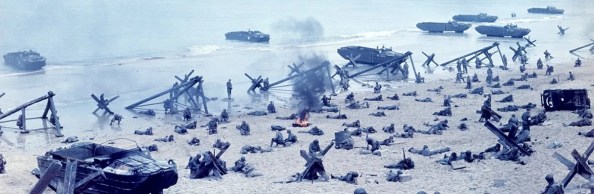
Normandy Beaches on D-Day
HISTORY OF D-DAY
Why has D-Day captured the imagination of American consciousness for over three-quarters of a century?
Eighty-two years ago, on June 6, 1944, the Allies launched an offensive on the Normandy coast of France to liberate continental Europe from the Nazi German occupation. On Twitter/X, the hashtag is #DDay82
D-Day was the largest invasion by sea and air in history, literally turning the tide. It was the beginning of the end of the War.
General Eisenhower, Supreme Commander of Allied Forces, sent the troops out that day:
“You are about to embark upon the Great Crusade, toward which we have striven these many months. The eyes of the world are upon you. I have full confidence in your courage, devotion to duty, and skill in battle.”
Reading Time: 7 minutes
 HISTORY OF THE SUMMER OF LOVE – 1967: PART 4, ROCK & ROLL
It was twenty years ago today
Sgt. Pepper taught the band to play
They’ve been going in and out of style
But they’re guaranteed to raise a smile
Rock & Roll in the late ’60s was exemplified when The Beatles released Sgt. Pepper’s Lonely Hearts Club Band in the U.S. on June 2, 1967. It was released in the U.K. the day before. No other rock & roll album defined the soundtrack of the Summer of Love better than Sgt. Pepper. It captured the fantasy, psychedelics, love, and drugs of 1967. Especially with the last song, “A Day In The Life,” which urged:
“I’d love to turn you on.”